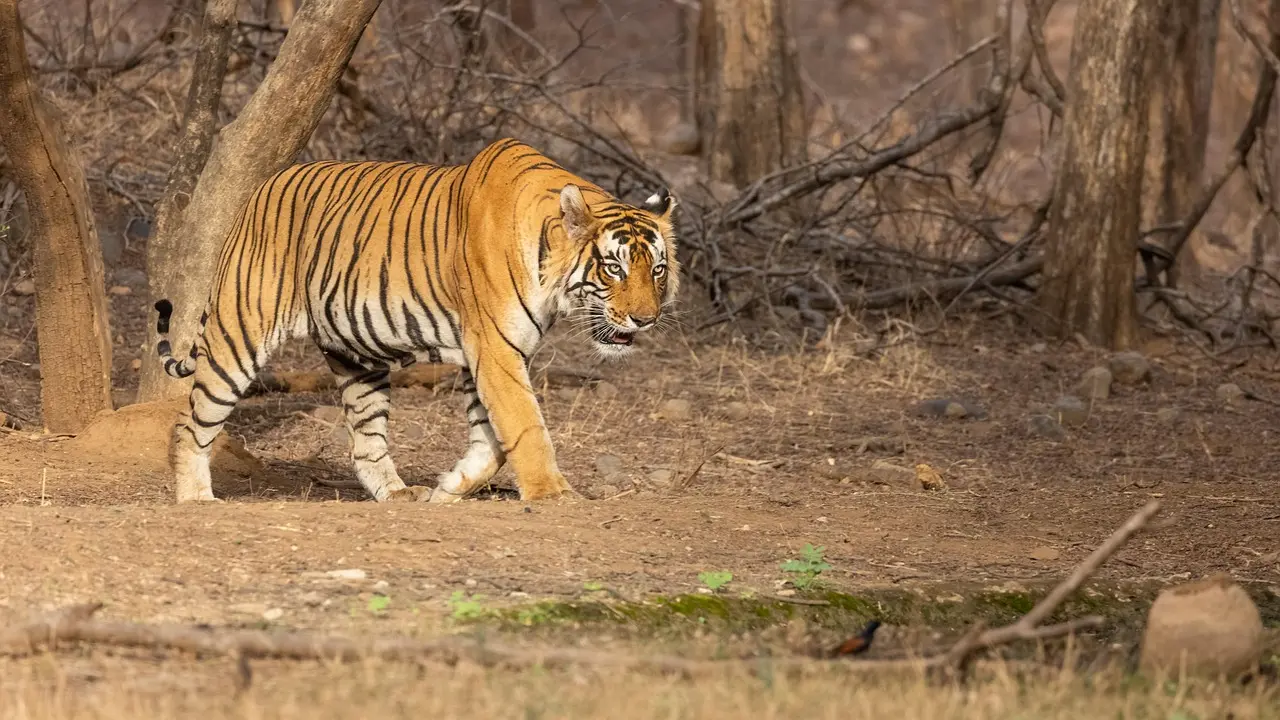
A new study published in the journal Oryx – The International Journal of Conservation on April 23, 2026, has found that Kawal Tiger Reserve has sufficient prey density to support a population of more than 35 tigers. However, researchers caution that ecological capacity alone will not ensure recovery, pointing instead to habitat connectivity and human-wildlife conflict as major constraints.
No Breeding Population Despite Reserve Status
Declared a tiger reserve in 2012, Kawal currently does not have a resident breeding tiger population. Over the past decade, 15 tigers have dispersed into the reserve from neighbouring regions, primarily from Tadoba–Andhari Tiger Reserve. However, only two of these were females, significantly limiting the chances of establishing a stable breeding population.
Long-Term Data Tracks Prey Trends
The study, led by Imran Siddiqui of the Centre for Wildlife Studies and the Hyderabad Tiger Conservation Society, analysed long-term data collected between 2010 and 2022.
Researchers conducted surveys across seven sampling periods using 28 line transects, each measuring 4 kilometres, to assess populations of five key prey species. The findings show that chital populations have increased over time, while sambar, nilgai and chousingha populations remained stable. Wild pig populations showed fluctuations during the study period.
Using prey abundance and biomass models, the team estimated that Kawal’s core area has the ecological capacity to support approximately 35 to 41 tigers.
Connectivity Barriers Limit Tiger Movement
Despite adequate prey availability, the study identifies fragmented landscapes as a major obstacle to tiger recovery. Infrastructure such as highways, railway lines, open-cast mines and dense human settlements disrupt natural corridors between Kawal and nearby tiger habitats.
While monitoring data from 2019 to 2025 indicates that tigers are attempting to disperse into Kawal through multiple routes, their movement is frequently hindered. The study recommends strengthening wildlife corridors, particularly through the Kagaznagar Forest Division, including the construction of overpasses and underpasses to facilitate safe movement.
Human-Wildlife Conflict Remains a Concern
The research also underscores the role of local communities in conservation outcomes. Around 30 villages located within the reserve’s core area depend heavily on forest resources. Activities such as livestock grazing, the presence of free-ranging dogs and illegal snaring continue to pose threats to wildlife.
The authors stress that long-term conservation success will depend on integrating community needs. Suggested measures include revenue-sharing models, alternative livelihood opportunities and timely compensation for losses caused by wildlife.
Assisted Dispersal May Be Needed
To achieve a viable tiger population of 30–35 individuals, the study suggests that assisted dispersal – particularly of female tigers – may be necessary. Such interventions would need to be carried out under the guidance of the National Tiger Conservation Authority.
Researchers also emphasise the importance of continued long-term monitoring of prey populations as a key ecological indicator to guide adaptive management strategies.
Key Findings at a Glance
– Long-term data indicates sufficient prey density in Kawal Tiger Reserve to support over 35 tigers.
– The reserve currently lacks a breeding population due to a low number of female tigers.
– Habitat fragmentation and weak corridor connectivity are major barriers to tiger recovery.
– Human-wildlife conflict and dependence on forest resources continue to pose challenges.
Experts recommend assisted dispersal, improved corridor infrastructure and stronger community engagement for sustainable conservation.