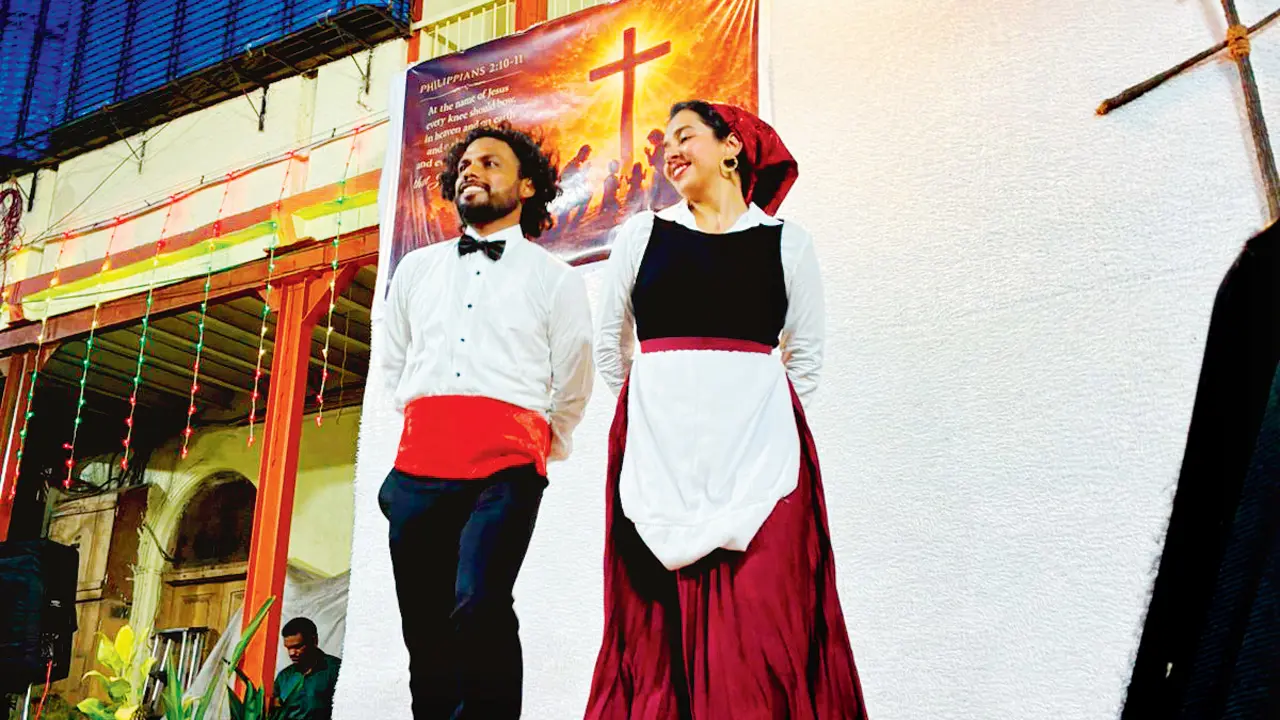
Not to be a contrarian, but Maria Pitache is not entirely Goan. For generations of Hindi cinema fans, it might be a mythbuster too far. “It is Damanese Creole,” shares Daniel Dias. The 25-year-old violinist and harpist from Mazgaon is amused. On May 1, Dias and sister Lisann, joined the Mazgaon Serenaders as they performed a compilation of Goan Mando, Dekhni, and Damanese songs at the Feast of the Holy Cross in the heritage precinct of Matharpacady village. “It was our first time performing Damanese songs though. People were surprised, but liked it,” reveals Dias.
Rooted music
It was the lockdown during the COVID-19 pandemic that nudged Dias towards this genre. Growing up in Mazgaon, Dias was always curious of his Goan roots. “I played the violin since I was five-years-old,” he shares. “I was reading up about Portuguese architecture, and cultural influences in India. I came across some songs online, and many of them were in Portuguese,” he reveals.
Origins
The musician hails from the parish of Our Lady of the Rosary in Dockyard Road that still carries remnants of the old connection. “The parish still has a Portuguese grave dating back to 1795, as well as the symbols NSR (Nossa Senhora do Rosário) on the gates,” he says.
Verses from Rapsodia de Cantares de Damao that inspired Maria Pitache
This influence is stronger across Goa, Daman, and Diu that were under Portuguese rule for much longer. Damanese music, Dias points out, is similar in style to Mando — a musical form from Goa. “The Mando bears resemblance to Portuguese and Brazilian music in the way it moves from major to minor chords,” he points out.
Daman tales
Remo Fernandes. Pics Courtesy/Daniel Dias; Wikimedia Commons
In the Union Territory of Daman, language played a part too. Many of the songs are in Portuguese Creole. One of them is a series titled ‘Rapsodia de Cantares de Damao,’ out of which the iconic melody of Maria Pitache, made famous by Remo Fernandes, emerged.
“Daniel had been playing these songs at home even before we performed, and some of these were songs we play at Goan weddings. I never realised they were from Daman,” she says. Several of the songs are just a couple of verses long, but the performers would adapt the tunes to their preference.
Lisann Dias and Daniel Dias
While the key accompaniments remain the violin, the guitar, and the ghumot, what sets the compositions apart is the vocals. “They are sung in harmony, a common trait in Western music, but they use climbing and falling notes common to Indian music. Even though it is Western in style, it has an Indian soul,” he observes.
Carrying on a tradition
With a large number of parishioners across the city sharing Portuguese roots, Dias hopes to carry this on. “I am looking to compile more songs, and we hope to perform them in the days to come,” he shares. We shall keep our ears open.
Log on to @daniel.harpist on Instagram (for details)
Cultural synthesis
Dekhni is a traditional Goan dance and music form that dates back to the 19th Century. The performance conveys the way of life of the community, using traditional Indian music in Goan patois
Straight from Lisbon
While it is read in Portuguese Creole, the Damanese dialect is written in Roman script, much like Portuguese