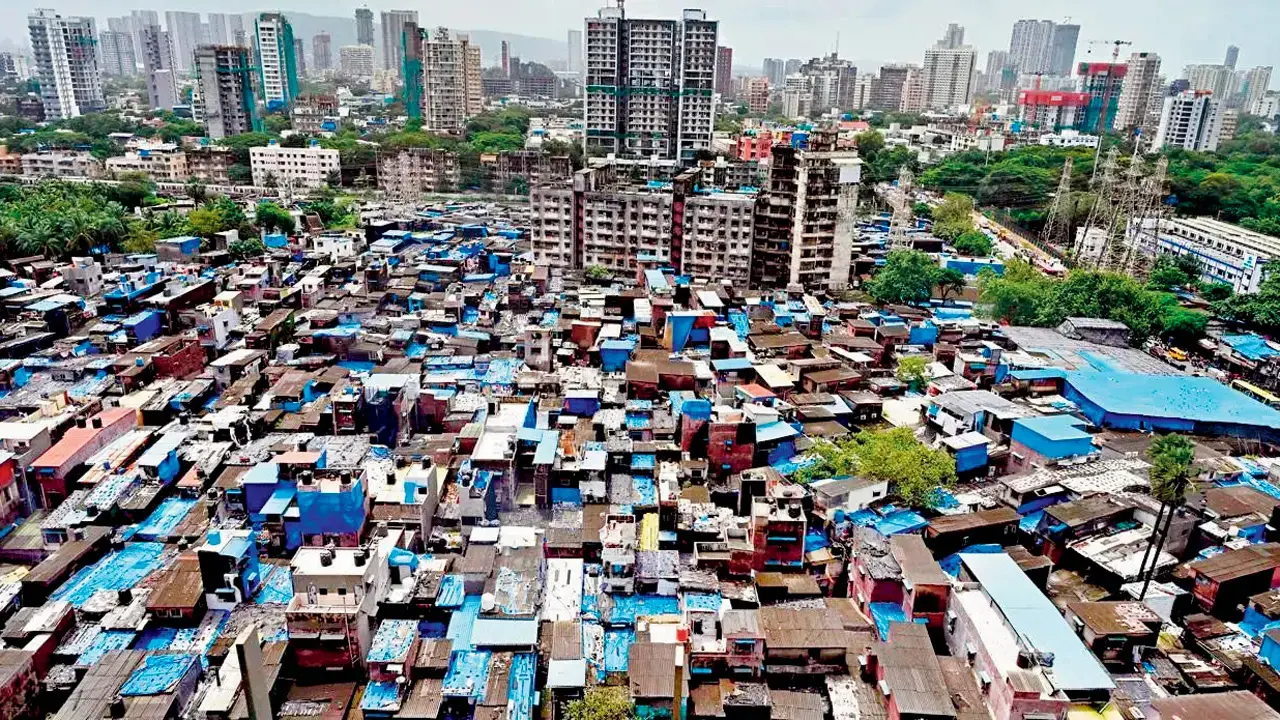
Eligibility for upper-floor residents under Mumbai`s Dharavi Redevelopment Project (DRP) is partly linked to the status of ground-floor occupants, with affidavits considered valid only if the lower unit qualifies, news agency PTI reported, quoting officials.
A government resolution issued on October 4, 2024, extends benefits to upper-floor residents who can prove occupancy before the November 15, 2022, cut-off.
Eligible families will be allotted 300 sq ft homes outside Dharavi but within the Mumbai Metropolitan Region, PTI reported.
Beneficiaries can opt for a hire-purchase model, paying nominal rent for 25 years before ownership is transferred, or choose early ownership by paying a pre-approved amount.
Break from past slum rehabilitation models
Officials said the policy marks a significant shift from earlier slum rehabilitation schemes, which typically excluded upper-floor occupants.
The Dharavi Redevelopment Project is being positioned as a more inclusive urban renewal initiative.
Eligibility based on document hierarchy
Eligibility is determined through a structured hierarchy of documents. At the top are electricity bills in the family head’s name, showing the upper-floor address, one dated before the cut-off and one recent.
This is followed by registered rent agreements and registered purchase agreements with supporting notarised consent letters.
Government-issued IDs such as Aadhaar, passport, ration card, driving licence, or voter ID showing the upper-floor address fall under the fourth priority.
Affidavits lowest priority, linked to ground-floor status
At the fifth and lowest priority level are affidavits submitted by upper-floor residents, which must be certified by an eligible ground-floor occupant.
Officials clarified that if the ground-floor household is disqualified, upper-floor applicants relying on affidavits will also become ineligible.
“An affidavit will not be considered in such cases,” a DRP official said.
Most upper-floor applicants are currently applying under this category, indicating limited access to higher-priority documentation.
Multiple units and claim restrictions clarified
The DRP has also received applications involving multiple units on a single upper floor. Officials said each unit must submit separate documents under higher-priority categories.
Alternatively, multiple households can apply as a single unit under the affidavit provision, subject to certification by an eligible ground-floor resident.
The policy allows only one home per family and prohibits separate claims by spouses or children. Applicants who already own property under any housing scheme within the Mumbai Metropolitan Region are not eligible.
Investigation and verification ongoing
Authorities are continuing scrutiny of applications and documents to verify eligibility and prevent duplication or misuse, while also working to identify genuine beneficiaries under the scheme.
(With PTI inputs)