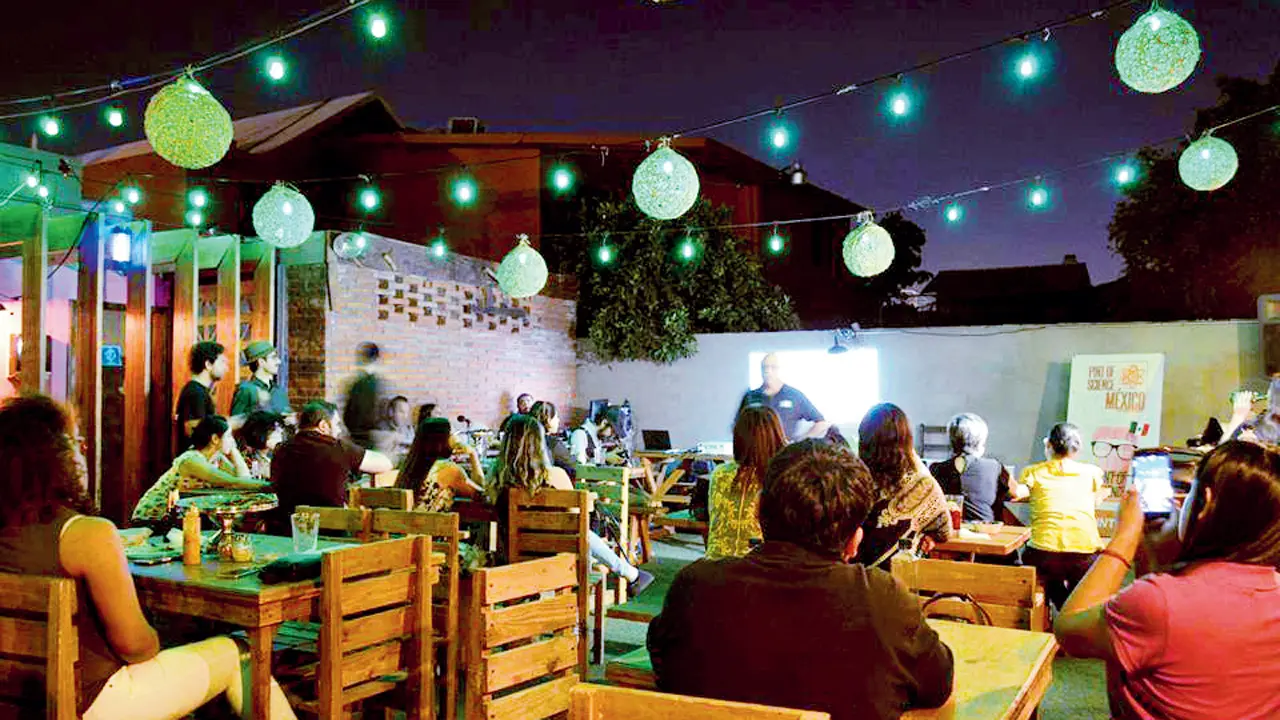
In the late 1960s, if you’d wandered into the notorious Giannoni’s in California, you would have stumbled into Richard Feynman working by a secluded bar table. It was Feynman’s favoured workspace. On May 18, the city will play host to the international community of Pint of Science as they make their debut with a three-day event at Khar, trying to replicate Feynman’s experience with a fun twist.
While there has been a growing trend of pubs playing host to complex conversations, Debarati Chatterjee, director, Pint of Science India, assures us that this is different. The theoretical astrophysicist, professor at Inter University Centre of Astronomy and Physics (IUCAA, Pune) first encountered this phenomenon in France during her research years. “The festival began in 2012 when two neuroscientists, Dr Praveen Paul and Dr Michael Motskin from the Imperial College of London, attempted to bridge the gap between patients and researchers. I was a speaker at the festival for two years, and later volunteered as well,” she reveals.
Participants interact at the United Kingdom edition. Pics Courtesy/Pint of Science India; Representation pic/Istock
The festival debuted in India in 2025 across several venues in Pune, Bengaluru, and Delhi. This year, Mumbai and Guwahati were added to the map. The decision to host it on weekdays also sets it apart. “Across the world, the weekends are usually crowded times for pubs, so weekdays are preferable,” Chatterjee explains.
Debarati Chatterjee
Thus, conversations from astrobiology and canine behaviour to marine evolution and black hole theory make the list. Chatterjee suggests that the conversations are simplified, but not simplistic. Starting September, the organisers worked with the speakers over several months to declutter the topic by reducing jargon, and adding familiar elements.
A moment from the Pune edition of the series in 2025
It is a new experience to many though. Dr Ankita Parab admits that speaking at a pub is unlike a session at an astrobiologists’ conference. “I am nervous about it. I have the experience of presenting in conferences, but here I am only talking to a general audience who are not all from the scientific community.” Shaunak Modi, director, Coastal Conservation Foundation, adds, “With any form of research outreach or conservation, there tends to be an echo chamber. We keep talking to the same people. I am glad I would be speaking to an audience I would otherwise not reach.”
An interactive graphic used by Dr Ankita Parab to explain astrobiology
Chatterjee promises an evening of fun. “We don’t want to bring people to a bar, and bore them. There will be no equations or jargons, I promise. But it is a chance to have fun, chill out, and yet, meet scientists,” she says.
FROM May 18 to 20; 6 pm to 9 pm
AT Shah Millar House, Raj Kutir, near Khar railway station, Khar West.
LOG ON TO pintofscience.in (to register; full itinerary)
ENTRY Rs 413 (per session)
Our fave events to catch
>> From anxiety to agency: Responsible AI operationalisation by Parveen Goribindhur
ON May 18
>> Peeping into the daily lives of street dogs by Professor Anindita Bhadra
ON May 18
>> Tigers, trees, and billions by Vishal Rasal
ON May 19
>> Mumbai, marines, mammals, and man by Shaunak Modi
On May 19
>> Growing life beyond earth by Dr Ankita Parab
ON May 20