Are you beside the mysterious blue-eyed woman?”
“No. But I see an old man.”
“Okay, keep walking till you spot the butterflies. I’m there.”
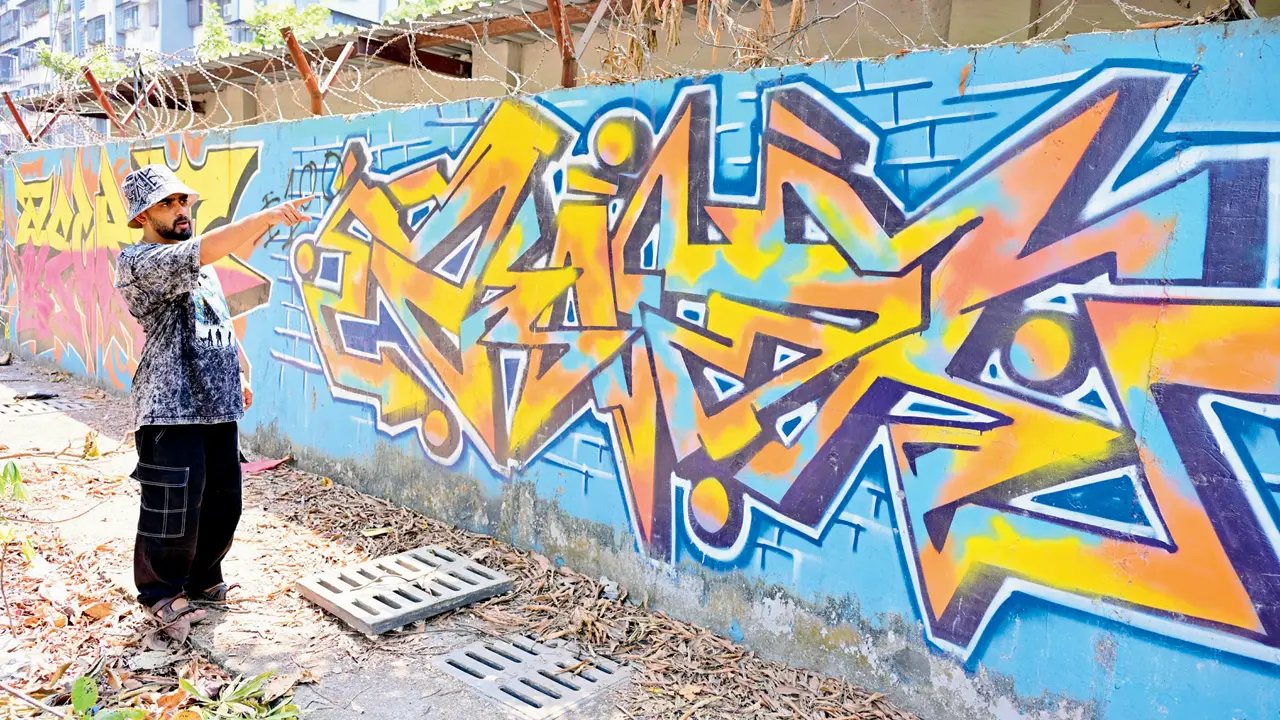
These are the kind of bizarre directions you’ll find yourself exchanging in Marol. They are all characters from street art works that dot a 1.5 km-radius area that constitutes the Marol Art Village. Over the years, it has hosted artists from Brazil to Borivli, who have all left a mark here.
A wall painted by artists in the Jabarpada chawl
The story begins in Eco Park Society in Marol, where co-founder Omkar Dhareshwar resides. With co-founder Zain Siddiqui — whom he met in the first week of college in Lonavla — the duo first cracked open a spraycan to add color and character to a typically urban locality. While Siddiqui has since moved cities to Bhopal, we catch up with Dhareshwar for a trip down memory lane.
Excerpts from the interview.
Graffiti at Bharat Van, a BMC-run park that has transformed into a hotspot for graffiti and hip-hop jams
Can you take us back to the first graffiti that sparked the movement?
In 2015, we brought together a group of eight artists, including Mooz, NME, and Minzo to paint on the walls of my housing complex’s clubhouse. Within 24 hours, the space became unrecognisable, with artworks splashed on each wall. The residents loved it so much, they gathered around it with pizza and beers that night to celebrate. None of us could have imagined it.
The Eco Park Society clubhouse in its recent avatar
Unfortunately, the space was repainted within months. But it taught us the importance of having strength in numbers. We painted many walls over the next two years, including chawls, and hidden lanes. As for the name, it has an unlikely link to South America. In 2018, we met Chilean street artist Ricardo Santander during his tour of India. When he returned in 2019, he asked us, “Take me to the art village.” The name stuck.
Did the neighbourhood support you in this quest to carve a new identity?
Interestingly, one of our earliest cheerleaders were residents of the Jabarpada chawl nearby, who welcomed our art with open arms. Imagine a group of female international artists feeling at home in these winding lanes. An old lady even bought new curtains to match the colours of the graffiti on her wall.
Street art created during the Ladies First initative
We were soon noticed by the Military Road Residents Welfare Association (MRRWA), a citizens’ group in Marol, who offered help. We don’t need funds, we said. We had too many artists, and few walls to paint. The association became the bridge between us and building owners.
There might have been cases where you still drew residents’ ire…
Of course. In 2019, we started planning a new chapter called Ladies First in an attempt to give female street artists a platform. It brought in artists from as far as Boston, USA. Shirin Shaikh, a talented artist, had planned to paint a building’s facade with a black-and-white piece featuring a young girl and her hopes. The crane was rolled in, and the scaffolding was laid out. At the eleventh hour, the residents called it off, deeming the piece ‘too depressing’. We went ahead with a mural of an Asian Flycatcher bird instead.
One of the first artworks painted at Eco Park Society’s clubhouse
Let’s address the elephant in the room. Is it entirely legal to paint these large walls across the neighbourhood?
They are all perfectly legal. We always acquire permissions from the housing society that owns the wall or facade. The popular opinion that street art has to be subversive and practised elusively is not entirely true, at least in Mumbai. In the past, we’ve had policemen stop by during our painting sessions and cheer us on. We’re not sworn enemies. My view, which irks some graffiti artists that I work with, is that street art can be legal, meaningful, and useful in the Indian context.
The neighbourhood hosts more than 200 graffiti works
With the inevitable gentrification, and redevelopment, will these artworks be lost to time?
Not quite. In fact, we have grown stronger. A one-kilometre stretch called the Wall of Fame is where all the buzz is right now. Over the next year, we plan to host guided walks there to introduce people to graffiti. If young artists need our support, we’ll gladly take them under our wing. As of 2026, nearly 150 artists have contributed towards the movement.
NME, Mooz, Krantinaari and Anpu Varkey
It’s true that the nature of our work is fluid — permissions, support, and the general attitude towards street art keep changing with time. I have lost count of how many walls have been repainted over in the last two decades. But somehow, we have, and will always find a way.
As seen in Marol
These globally acclaimed street artists have the neighborhood to thank for their early works
Numbers game
Ever wondered how much money artists invest in the eye-catching street art you see across the city and its suburbs?
Rs 3-4 L
Average cost of painting a larger-than-life mural on a building facade
Rs 4000
Average cost of painting a standard fence wall