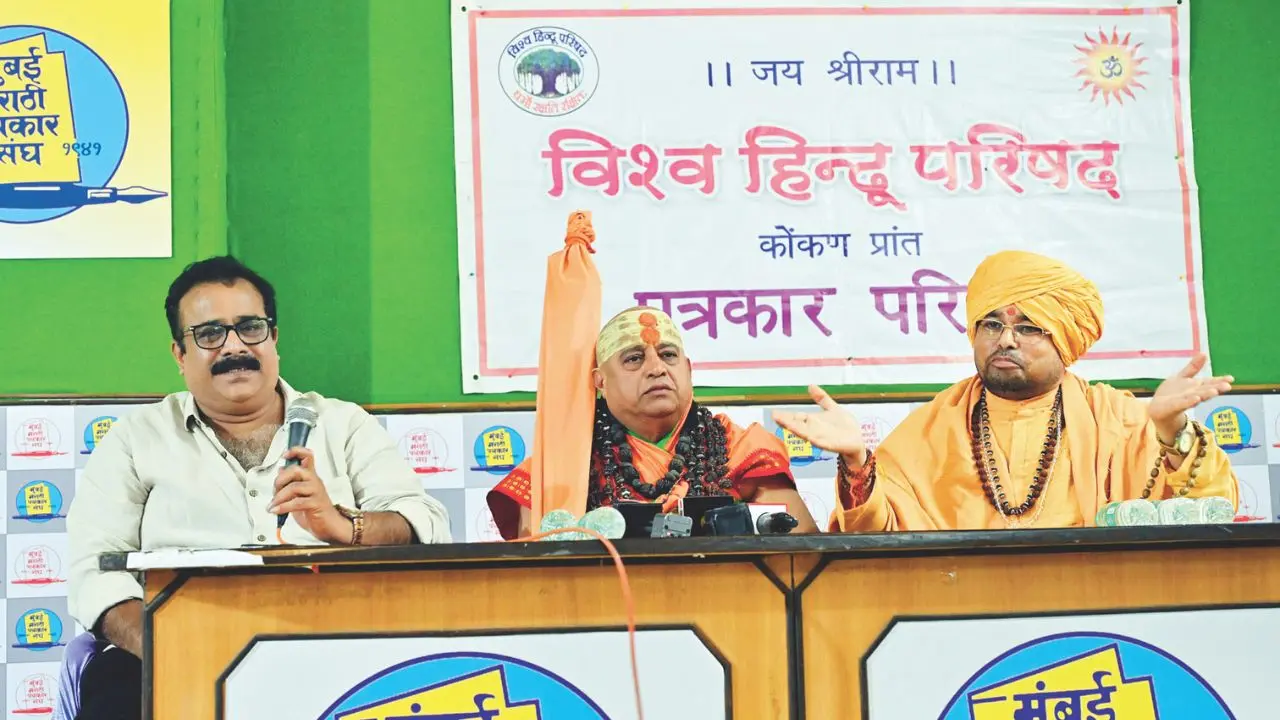
At a press conference held at the Mumbai Marathi Patrakar Sangh near Azad Maidan on Tuesday morning, prominent religious figures expressed strong support for the Maharashtra Freedom of Religion Bill 2026, recently passed in the state Assembly.
Addressing the media, Shriraj Nair, national spokesperson of the Vishwa Hindu Parishad, was joined by Jagadguru Suryacharya Shri Krishnadevanand Giriji Maharaj and Swami Shri Bharatanand Saraswati Maharaj. The panel congratulated the state government and Chief Minister Devendra Fadnavis for what they termed a “historic and joyous” legislative milestone.
The leaders said the Bill, passed on March 16, aims to safeguard individuals from religious conversions carried out through coercion, fraud, inducement, or marriage. They asserted that the legislation would help preserve religious freedom while preventing exploitation under the guise of conversion.
Freedom of Religion Bill to curb forced religious conversions
The Maharashtra government earlier on March 13 introduced the Freedom of Religion Bill, 2026, aimed at curbing religious conversions carried out through force, fraud, coercion or inducement. The proposed legislation seeks to regulate religious conversions while safeguarding the constitutional right to freedom of religion.
The Bill, also referred to as the Dharma Swatantrya Adhiniyam, 2026, was tabled in the Maharashtra Legislative Assembly by Minister of State for Rural Development Pankaj Bhoyar. The state Cabinet had earlier approved the draft legislation on March 5.
The proposed law mandates that individuals intending to convert to another religion must provide a 60-day prior notice to the authorities. After the conversion, the individual will also be required to complete registration within 25 days, as per the provisions of the Bill.
Stringent punishments proposed
The legislation proposes strict penalties for unlawful religious conversions. Those found guilty of carrying out conversions on the pretext of marriage could face imprisonment of up to seven years and a fine of Rs 1 lakh.
In cases involving minors, women, persons of unsound mind, or individuals belonging to Scheduled Castes and the Scheduled Tribes, the punishment may extend to seven years of imprisonment and a fine of Rs 5 lakh.
The Bill also prescribes penalties for mass conversions, defined as the conversion of two or more persons simultaneously. Offenders in such cases may face seven years in prison and a fine of Rs 5 lakh. Repeat offenders could face up to 10 years of imprisonment along with a fine of Rs 5 lakh, according to the proposed law.