The ongoing LPG shortage has begun to disrupt Mumbai’s fabric dyeing industry, a sector heavily dependent on gas for processing textiles. With cylinder supply turning erratic, small-scale dyers are struggling to sustain operations, triggering delays and losses.
Supply crunch
Fabric retailers and wholesalers across the city report a sharp slowdown. Small dyers, who form the backbone of the business, are bearing the brunt of rising costs and irregular supply. “Till before COVID, we had seven dyeing partners. That was reduced to four post-COVID. Now even these four have returned to their hometowns, leaving us unable to supply dyed dupattas,” said Ram Dedhia, owner of Ankur Dupatta Ghar in Dadar.
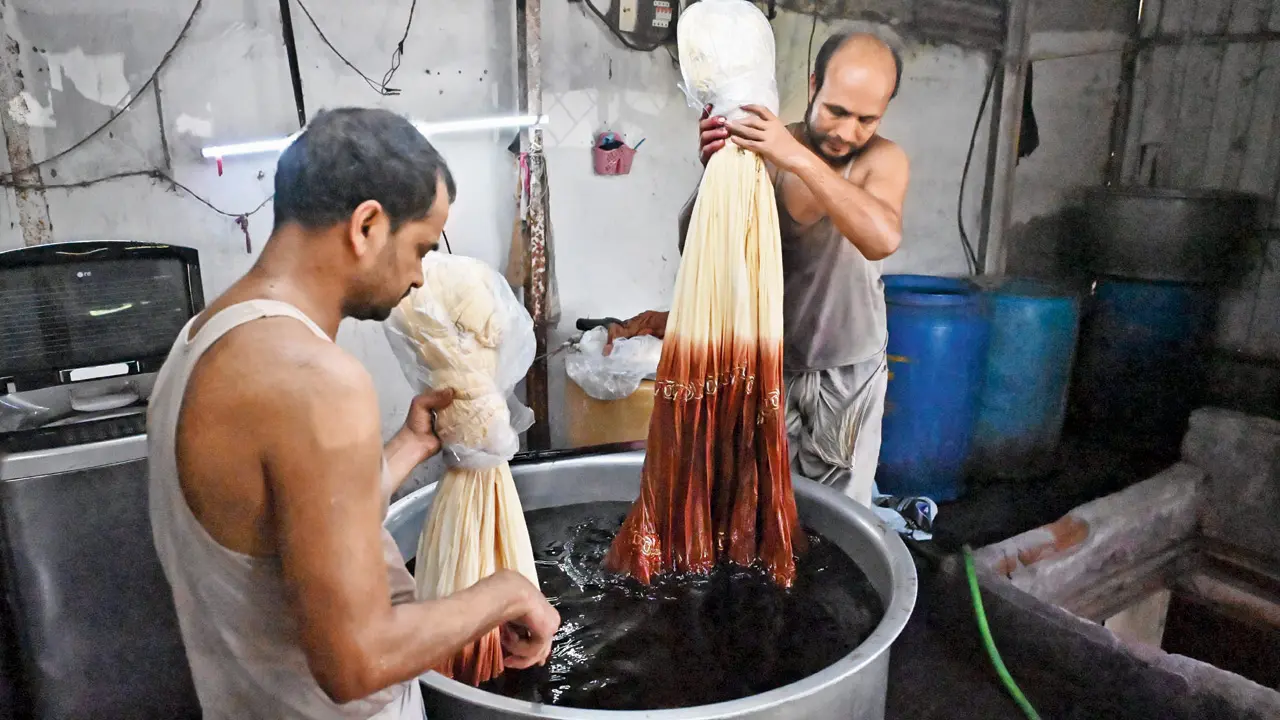
Mohammed Amir at his Dharavi dyeing unit, where falling cylinder supply has cut output sharply and slashed his daily earnings
Units shut
A visit to Dharavi, the city’s largest dyeing hub, revealed that 75 per cent of dyers have exited the trade. “This lane had 15-16 units; now it`s just two of us, but we are struggling too and do not know till when we can sustain,” said Mohammed Amir, a dyer since 2012. His daily earnings have dropped from Rs 8000 to Rs 1000 in the past month. “Earlier, we got cylinders every alternate day and dyed up to 1000 metres daily. Now supply comes once in 7-10 days, cutting output to 100 metres,” he said.
Costs spike
Raji Haider, who has been in dyeing business for two decades
‘Even when available, cylinders now cost double. We would get one cylinder for `1600 to `1700 earlier. Now it is `3600 to `4000. Earlier, we were able to work on two gas stoves using two cylinders simultaneously, with which we could dye 1000-1500 metres a day. Now, with just one cylinder, which we also have to use very wisely, we are able to dye only 400-500 metres every day, our daily earnings have dropped from `15,000 daily to `6000’
Faizan Shaikh, retailer
‘Earlier, small dyeing orders were completed the next day. Now it takes three to four days even for basic work’
Why gas matters here
>> Dye baths need 60-100 degrees C heat to dissolve colours, with LPG cylinders preferred for consistent temperatures during the process
>> If dyes are not fixed at the right, temperature, colours can turn dull, uneven, or wash out easily
>> After dyeing, fabrics are boiled and washed repeatedly to remove excess dye, a process powered by gas-fired boilers