Flamingo numbers at the Thane Creek Flamingo Sanctuary are expected to rise over the next two weeks, experts told mid-day, easing concerns among tourists and birdwatchers. The increase is expected as birds begin arriving from Kutch in Gujarat, where drying water bodies typically trigger their movement towards Mumbai and the Mumbai Metropolitan Region (MMR).
Adesh Shivkar, a naturalist and the director of Nature India Tours, said that the flamingo migration to Mumbai does not follow a fixed calendar and is largely driven by food and water availability. “This year, the monsoon extended longer than usual across Gujarat, and water remained in many wetlands. This meant algae — the flamingos’ main food source — was available for a longer period, leaving the birds with no immediate reason to move,” he said.
Shivkar added that as water levels in Gujarat recede due to rising temperatures and evaporation, visitors to the Thane Creek Flamingo Sanctuary can expect a fresh wave of arrivals. “Over the next two weeks, numbers are expected to increase significantly. Sudden spikes in sightings are normal and have been observed for decades. What has changed in recent years is public awareness, with more people tracking flamingos and social media amplifying every fluctuation. Earlier, such variations went largely unnoticed. The current trend is consistent with long-term patterns, and there is no cause for concern,” he said.
Naturalist and birder Sachin Rane, founder of the Naturalist Foundation, who regularly visits the Bhandup Pumping Station and Thane Creek Flamingo Sanctuary, told mid-day that flamingo flocks are fewer compared to February last year. “Flamingo arrivals in Mumbai have always fluctuated depending on rainfall patterns and food availability, so this year’s delayed arrival is not unusual. The extended monsoon and prolonged water availability in Gujarat meant the birds stayed back. As those wetlands dry up, they are now moving towards Mumbai,” Rane said.
Spotting zones
Every year, thousands of flamingos arrive in and around Mumbai, with Thane Creek, Airoli, Mahul, and Sewri emerging as major hotspots.
Flamingo facts
Since 1994, Thane Creek has attracted large numbers of flamingos. By November, these birds and their chicks usually settle on the mangrove-lined mudflats and stay until May. Most then migrate to Bhuj in Gujarat for breeding, leaving behind a small resident population. Nearly 90 per cent of the flamingos that visit the city are lesser flamingos, while the remaining are greater flamingos.
Indian flamingos
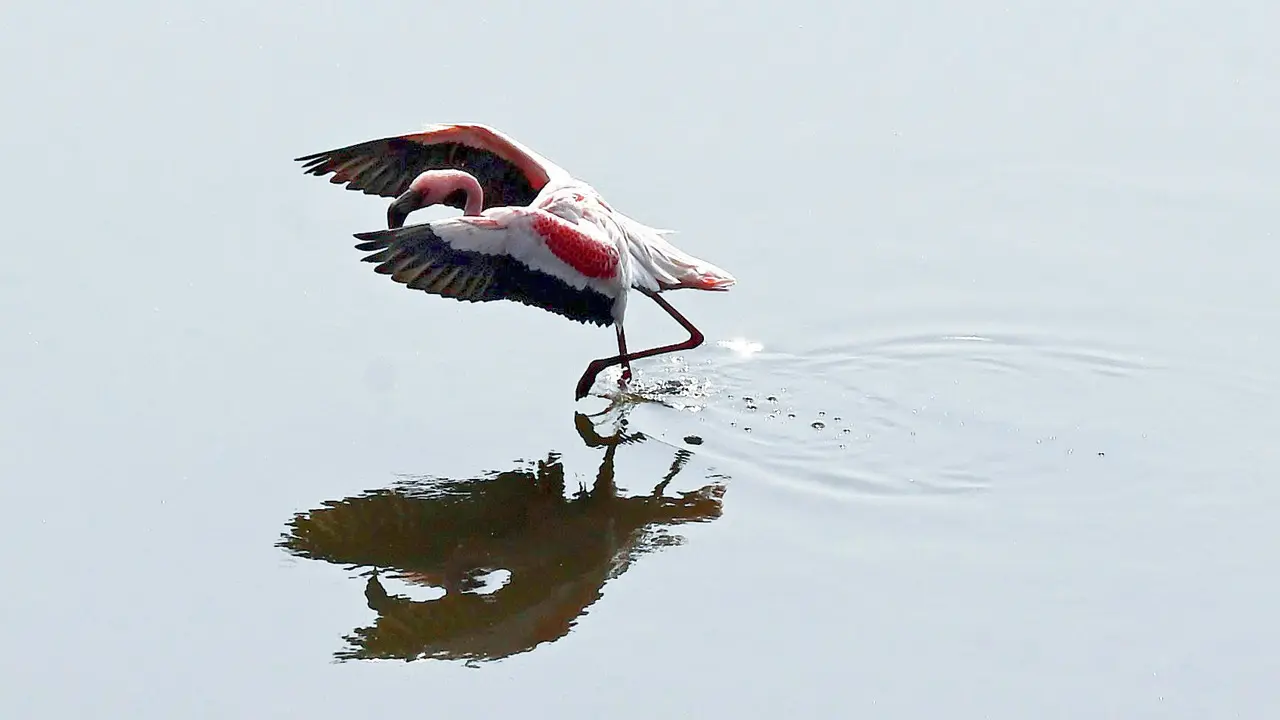
Of the six flamingo species found worldwide, two are seen in India — the Greater Flamingo (Phoenicopterus roseus), the tallest species, and the Lesser Flamingo (Phoeniconaias minor), the smallest. Greater flamingos are taller, with light pink bodies, black-tipped pale beaks, yellowish eyes and a distinctive S-shaped neck. Lesser flamingos are smaller, deeper pink in colour, with dark beaks, red eyes and a J-shaped neck.