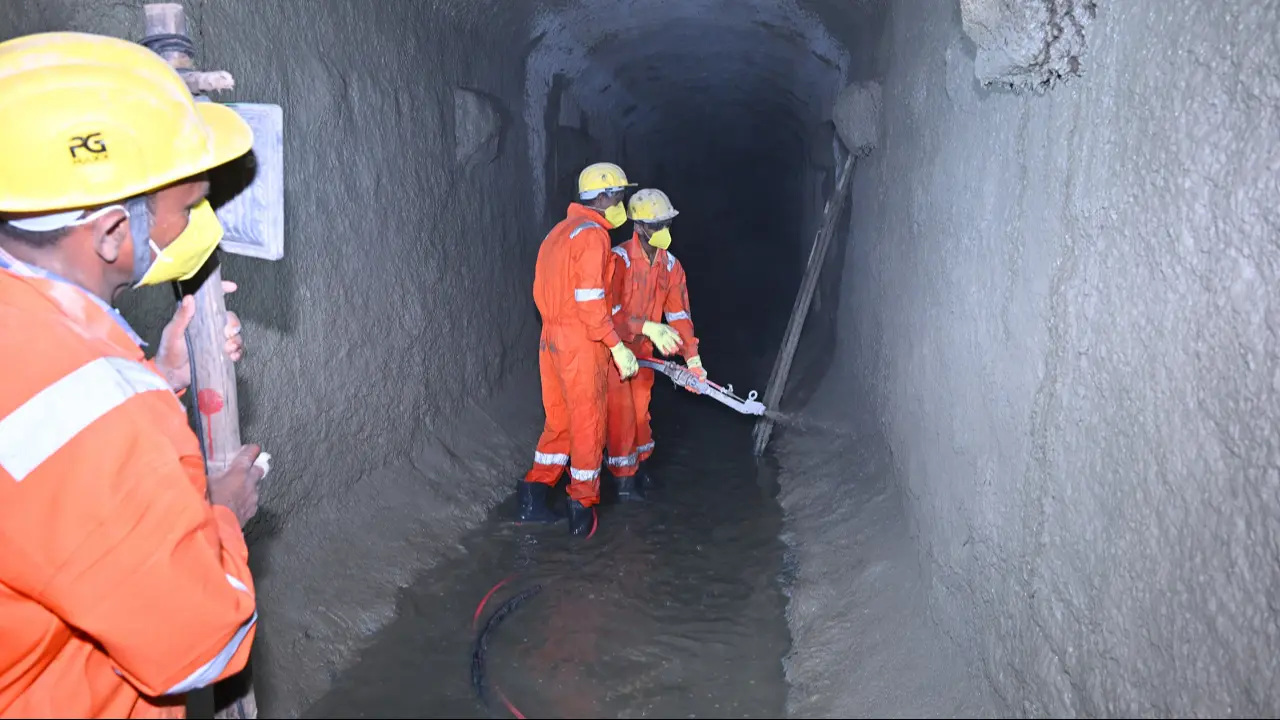
The Brihanmumbai Municipal Corporation (BMC) has initiated a major infrastructure upgrade to strengthen over a century-old network of underground arch stormwater drains in the island city, using geopolymer lining through trenchless technology.
The civic body said the intervention aims to significantly improve the structural integrity of British-era drains while enhancing their capacity to discharge rainwater more efficiently during heavy downpours. Officials estimate that the upgrade could extend the lifespan of these drains by at least 50 years.
Focus on ageing and vulnerable infrastructure
Mumbai’s stormwater drainage system—much of which dates back over 100 years—has been under increasing strain due to rapid urbanisation and more frequent extreme rainfall events. The city’s geography, bounded by the Arabian Sea and influenced by tidal conditions, further complicates drainage, especially during high tide.
According to civic data, the island city alone has a 495-km-long stormwater drain network, while the eastern and western suburbs account for an additional 63 km each. In total, Mumbai’s arch and closed drain network spans 621 km.
Routine maintenance such as desilting is carried out annually. However, recent CCTV inspections conducted by the BMC’s operations and maintenance teams revealed widespread structural deterioration in several sections of the underground drains.
These include cracks in masonry, displaced bricks, damaged joints, partial roof collapses and other defects that could compromise drainage efficiency during intense rainfall.
CCTV surveys flag urgent repairs
Based on these findings, 56 arch drains measuring a combined 23.5 km were identified as being in poor condition. Of these, 27 drains covering 14.28 km have been prioritised for urgent rehabilitation under Phase 1 of the project.
Currently, lining work is underway across stretches totalling around 14 km.
Senior civic officials, including Deputy Municipal Commissioner (Infrastructure) Girish Nikam and Chief Engineer (Storm Water Drains) Kalpana Raut, recently inspected ongoing work near the Shantiniketan outfall close to the Shamal Das Gandhi Marg flyover.
Trenchless technology to minimise disruption
The BMC has opted for geopolymer lining using trenchless technology—a method that allows repairs to be carried out without large-scale excavation. This is expected to reduce disruptions to traffic and daily life in densely populated parts of south Mumbai.
The technology was selected following consultations with experts from the Indian Institute of Technology Bombay and the Veermata Jijabai Technological Institute, and subsequent recommendations by a Technical Advisory Committee in November 2022.
While widely used in countries such as the United States, this marks the first large-scale application of geopolymer trenchless lining for stormwater drains in India.
Addressing flood risks amid extreme rainfall
In recent years, Mumbai has witnessed episodes of intense rainfall, with nearly 1,000 mm recorded within a few days in some instances, leading to widespread waterlogging in low-lying areas.
Civic officials said the upgraded lining will not only reinforce the structural stability of the drains but also improve internal flow characteristics, enabling faster discharge of stormwater.
Sustainable and long-term solution
Apart from durability, the BMC has highlighted the environmental benefits of geopolymer materials, which are considered more sustainable compared to conventional options.
With Phase 1 focusing on the most vulnerable sections, the project is expected to serve as a model for future upgrades across the city’s ageing drainage network, as Mumbai continues efforts to strengthen its flood mitigation infrastructure ahead of increasingly erratic monsoon patterns.