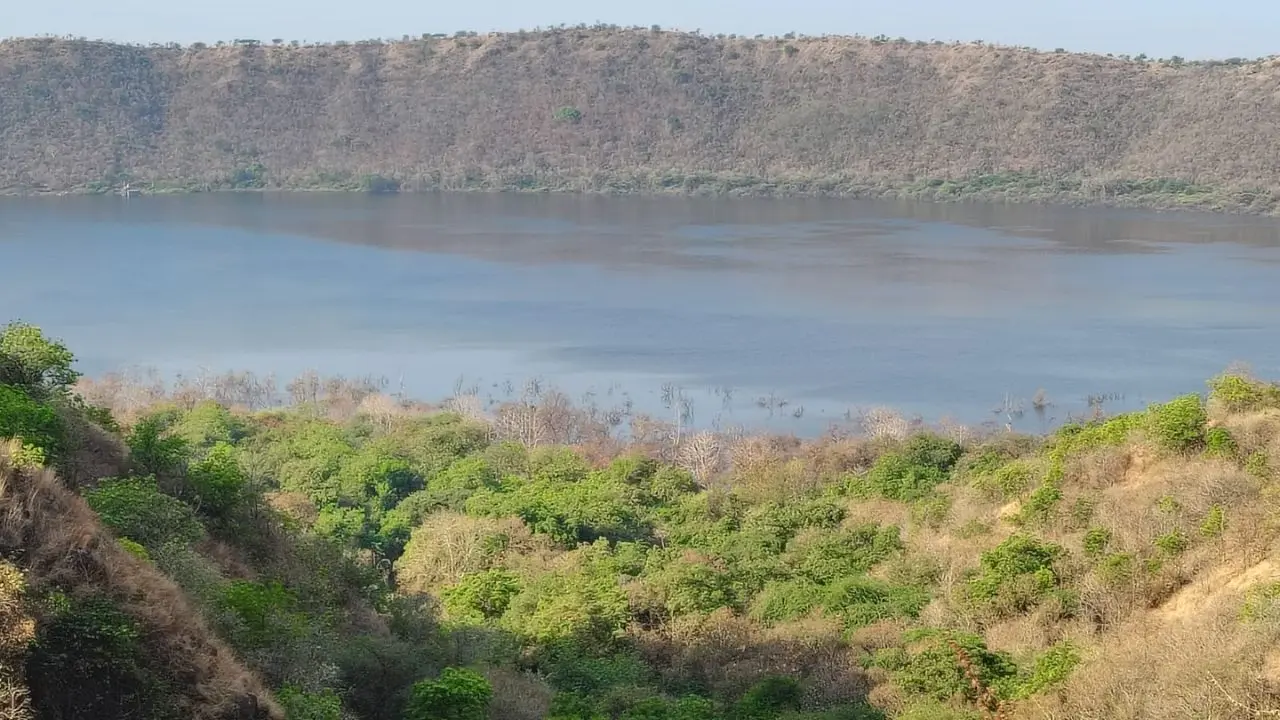
In one of India’s largest people-science initiatives, Lonar Lake, the iconic meteorite crater in Maharashtra’s Buldhana district, is set to be transformed into a vibrant centre for science, biodiversity, cultural heritage, archaeology, and sustainability.
The move aims to bring this National Geo-Heritage Monument closer to the public. Lonar Lake, formed nearly 50,000 years ago within the basaltic Deccan Plateau, is renowned for its ecological, geological, and planetary significance, with features resembling impact craters on the Moon and Mars.
The National Centre for Science Communicators (NCSC), Mumbai, in collaboration with the Nehru Science Centre, the Scientific Research Centre of Kelkar Education Trust, Mulund, and Late Ku Durga K Banmeru Science College, Lonar, held a one-day conference titled `Exploring Lonar Lake: Science, Biodiversity, Sustainability, and Cultural Heritage` to chart the roadmap for the lake’s preservation.
The conference highlighted the need for sustained research, science communication, policy support, and public participation to ensure the lake’s long-term conservation. Experts raised concerns over rising ecological stress, including sewage inflow, agricultural encroachment, excessive tourism, climate change impacts, and declining alkalinity, which indicate ecological imbalance.
“Lonar Crater or Lonar Lake is not just a site. If we look at Lonar town, it is a university in itself. While Lonar Lake is the focal point of attraction and geo-heritage site, there are temples which are known for their archaeology and mythology. Besides, there is rich biodiversity and birdlife,” said NCSC Chief Executive Officer Suhas Naik-Satam, one of the leading science communicators.
As part of the initiative, a Centre for Excellence in Lunar Exploration (CELE) will be established at Ku Durga K Banmeru Science College to engage the public in lunar science and planetary research and make complex scientific issues accessible to common citizens.
Conference highlights
Conference convenor and College Principal Dr Prakash K Banmeru highlighted Lonar’s global relevance as a multidisciplinary research hub.
In his presidential address, NCSC Chairman Siddhivinayak Barve called for a dedicated National Lonar Lake Research and Conservation Laboratory to ensure long-term ecological protection.
Former University of Mumbai Vice-Chancellor Sanjay Deshmukh cautioned against unregulated tourism, stressing that poorly managed inflow could harm the lake’s fragile ecosystems.
Architect Samrat Sarode traced the evolution of Hemadpanthi temple architecture around the crater and pointed out key conservation challenges.
Veteran science journalist and NCSE Vice Chairman Vitthal Nadkarni explained the lake’s impact features, including shock-metamorphosed rocks and shatter cones, underscoring Lonar’s significance as a global field laboratory.
NCSC Secretary Chandrashekhar Marathe detailed the lake’s rich biodiversity, highlighting extremophile microorganisms, algal diversity, migratory birds, and unique flora.
Geologist Mayura Deshmukh linked the crater’s formation to the Deccan Traps, while researcher Ganesh D Gaikwad emphasised the importance of cultural heritage and community participation in conservation efforts.
In the valedictory address, Umesh Kumar Rustagi, director of the Nehru Science Centre, said such interdisciplinary platforms are crucial for integrating science, sustainability, and heritage.
A sky observation session conducted by Sheetal Chopade allowed participants hands-on experience with celestial observation, further enhancing the learning experience.