On January 31, animal welfare organisation, Upadhyaya Foundation organised the India Animal Welfare Forum (IAWF) at a venue in Bandra-Kurla Complex, gathering conservation experts, policymakers, and researchers, among others to deliberate on critical issues facing India’s wildlife. On the sidelines of the sessions, we reached to Dr Sanjay Molur, executive director, Zoo Outreach Organisation, for insights on the subject of his conversation: Snake conservation.
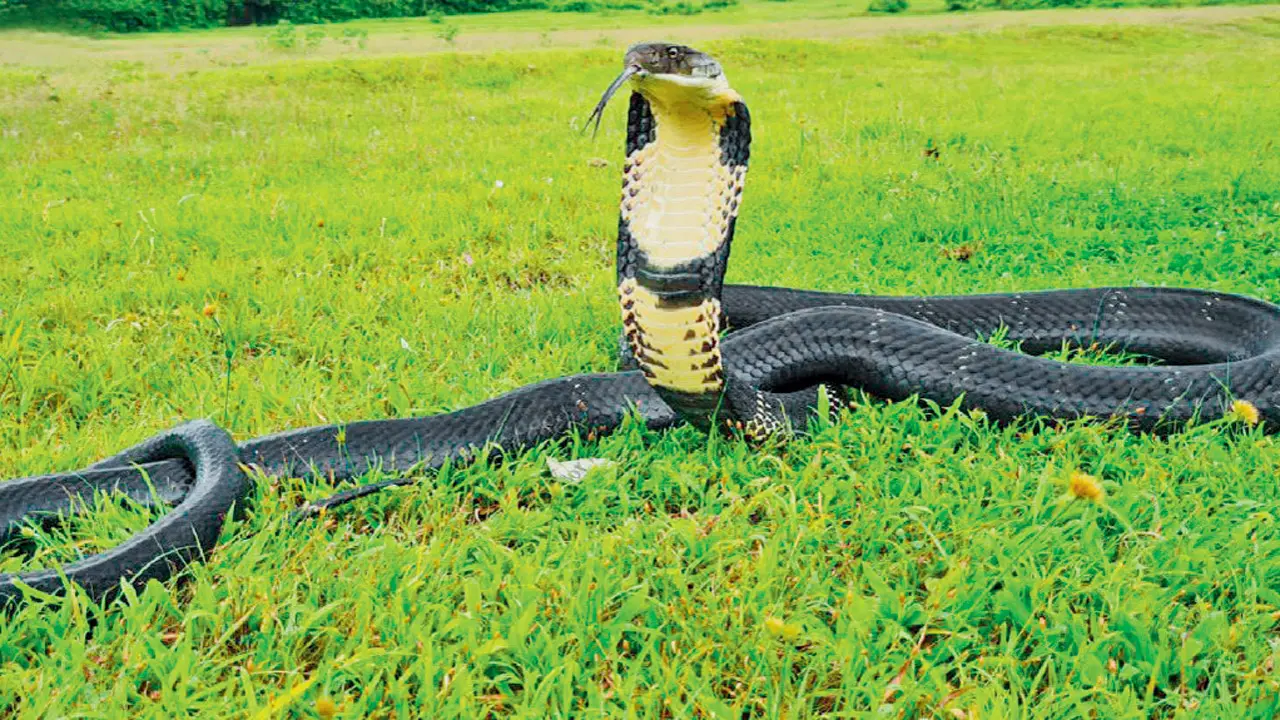
Wildlife biologist, Gowri Shankar (also a speaker at IAWF) handles a King Cobra
Excerpts from the interview.
What is most misunderstood about snakes? How does that make conservation harder?
It’s lack of knowledge and the common fear surrounding snakes in Indian society. Myths about snakes supposedly always being out to get you lead to very limited information, especially about the potential of certain snakes being venomous. Many aren’t venomous at all. This fear causes a slew of problems in snake encounters, as people simply don’t know how to respond in the moment.
An injured Indian Rock Python, rescued by members of wildlife rescue organisation, SARRP India (part of IAWF). Pics courtesy/Sarrp India; Gowri Shankar
What are some ways to reduce human-snake conflict, especially in Mumbai, which is home to the Sanjay Gandhi National Park?
Respond logically, not emotionally. Don’t create a ruckus, grab the snake or prod it with an object; this only increases chances of being bitten. Remember, snakes living in our vicinity have probably seen us multiple times before we see them once. They have no inherent conflict with us, which is why I discourage using the term ‘conflict’ at all; interactions, positive or negative, are usually what occur between humans and snakes. If a snake is outside the house, observe where it’s going; it has no business with humans, and will automatically find a way out. If it’s inside, ideally, create a distance or barrier between yourself and the reptile, and call a snake rescuer.
Dr Sanjay Molur
Could you share interesting facts that have emerged from recent research about snakes to help us understand them better?
Currently, ongoing research has discovered four species of the King Cobra, rather than a single one. Importantly, researchers are studying how snakes respond when relocated, especially if taken into captivity (after a scare in someone’s house, for example). After being released into new habitats, they starve and eventually die under the duress of being placed in an unfamiliar area, with nothing to anchor them. More research is required to see if multiple species respond similarly. These findings serve only to help reduce snake bites, which kill approximately 60,000 annually in India.
What should be done differently for snake conservation in an urban centre like Mumbai?
I’d advise Mumbaikars [especially those living amidst greenery] to learn to co-exist with snakes. Small steps like wearing footwear outside the house, carrying a torch in the dark, and not inserting your hands into random bushes to search for objects, are all acts that mitigate chances of snakes harming you in self-defence, and ultimately, contribute towards protecting them. Snakes have evolved to adapt to varied habitats, from forests to mangroves. Human settlements push them away, but they easily return. Removing a snake from your garden makes no difference; another one will replace it if there’s sufficient area to survive. Hence, learn more about them to avoid harming them or being harmed.
Log on to: zooreach.org