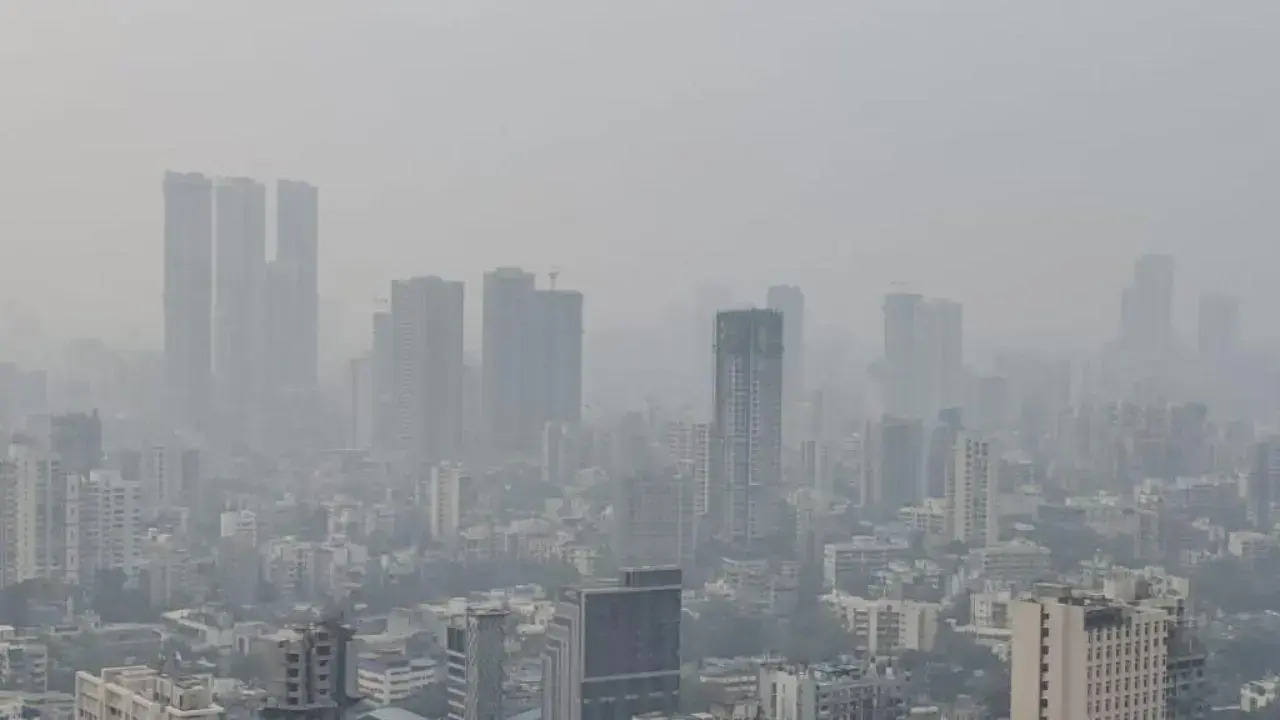
Mumbai woke up to cold and hazy conditions on Wednesday, February 4, 2026, with smog blanketing several parts of the city, once again highlighting concerns over deteriorating air quality that have persisted since the onset of winter.
According to the India Meteorological Department (IMD), the city is expected to witness clear weather by afternoon, with temperatures ranging between 20 degrees Celsius and 34 degrees Celsius. While temperatures have remained largely stable in recent days, air pollution levels have continued to fluctuate, raising health concerns among residents.
Data from the Sameer app indicated that the overall air quality index (AQI) in Mumbai stood at 136 on Wednesday, placing it in the ‘moderate’ category. Pollution levels varied significantly across locations, with Bandra-Kurla Complex recording an AQI of 147, Borivali East 131, Byculla 154, Andheri East 130, Chembur 127, Colaba 122, and Kandivali East 149. Ghatkopar registered an AQI of 156, Kandivali East 149, Malad West 152, and Mazgaon 144, while the Mumbai airport area reported the highest reading among key areas at 208.
Officials noted that PM10 remains the dominant pollutant, primarily driven by construction-related dust and vehicular emissions, contributing significantly to the city’s air quality concerns.
Dense fog blankets Delhi-NCR as air quality slips to ‘very poor’, AQI at 312
Delhi-NCR witnessed dense fog on Wednesday morning, accompanied by a sharp decline in air quality across the national capital. The overall air quality index (AQI) stood at 312 at around 7 am, placing it in the ‘very poor’ category.
According to data from the Central Pollution Control Board (CPCB), the city’s AQI largely fluctuated between moderate and poor levels.
Visuals from the Akshardham area earlier in the day showed a thick blanket of fog persisting across several parts of the city.
As per CPCB data, the ITO area experienced dense fog with reduced visibility, recording an AQI of 334, which fell under the ‘very poor’ category. Similar conditions were observed near India Gate and Kartavya Path, where a thick layer of smog continued to linger.
Several other locations in the capital also reported severely deteriorated air quality. Anand Vihar recorded an AQI of 376, Bawana 329, Ashok Vihar 366, Mundka 381, Chandni Chowk 358 and RK Puram 346, all remaining in the ‘very poor’ category. Sirifort also reported comparable conditions, with an AQI of 340.
Meanwhile, a few areas showed relatively better air quality. Narela and Aya Nagar both recorded an AQI of 252, placing them in the ‘poor’ category. Sri Aurobindo Marg (221), Mandir Marg (257) and IGI Airport T3 (243) also registered ‘poor’ air quality levels, though marginally improved compared to other parts of the city.
(With ANI inputs)