The immediate sign of not being in Mumbai is the absence of incessant honking. It feels almost uneasy at first as we drive into the village of Narlai on a warm April afternoon. Located at the foothills of the Aravallis, adjacent to the Kumbhalgarh range, the village offers an escape to tourists looking from the familiar destinations of Udaipur, Jodhpur, or Jaisalmer. “You have to be a traveller to discover this,” our driver Kishore reminds us.
The village entails 10 clusters of hamlets of communities as diverse as Jains, Mevashis, Bhils, and nomadic tribes. With education, mobility, and access, provided by the Maharaj Shri Swaroop Singh ji Charitable Trust (MSSCT), the village is keeping up with the pace of its more urban neighbours.
Royal repose
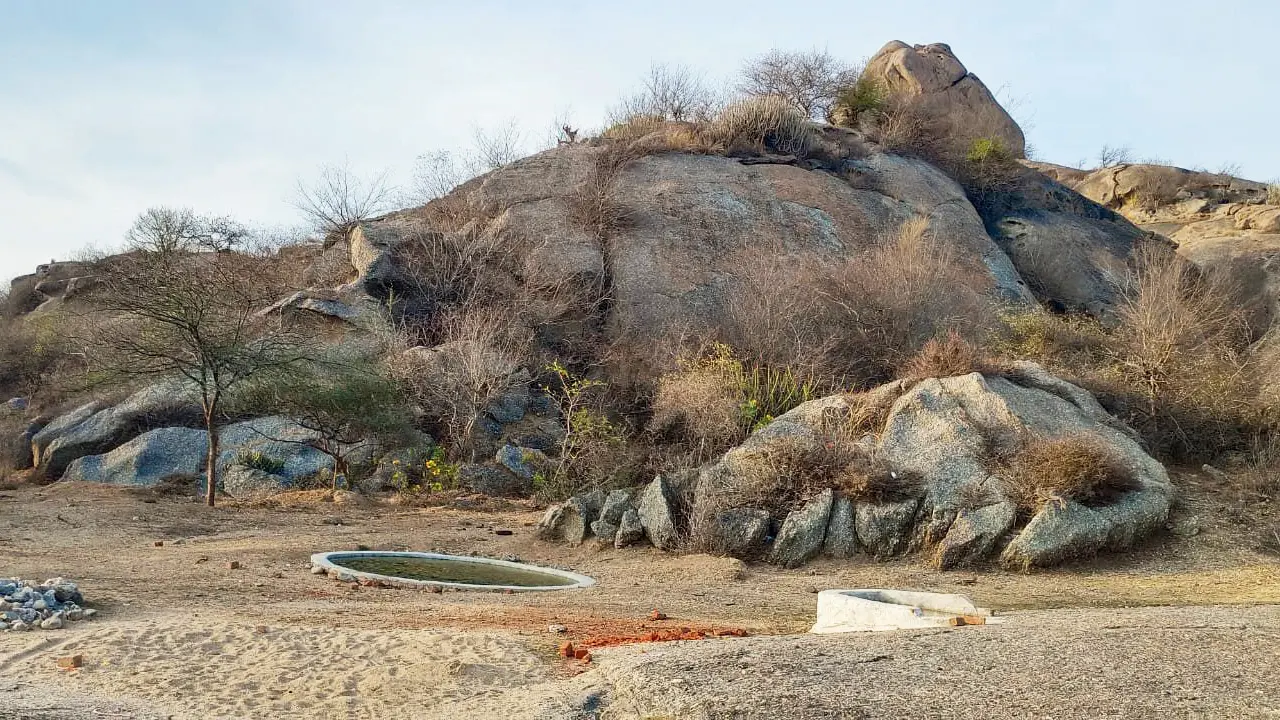
A stepwell reservoir on Elephant Hill
The palatial haveli of the Jodhpur family, Rawla Narlai, is at the heart of this change. In 1997, the late Maharaja Swaroop Singh and Rani Usha Devi transformed this 17th Century haveli into a heritage retreat to suit the tastes of a global traveller. “We hope to create a sustainable ecosystem that enriches the village, while providing a royal experience,” admits general manager, Kripalini Singh. While the structure of the palace and the open courtyard — still used for village meetings when the royals visit — remains unchanged, there are aesthetic additions overseen by another royal family member, acclaimed designer, Raghavendra Rathore.
Artefacts and sculptures left behind by villagers during theri trips to the temple. Pics/Shriram Iyengar
Hidden world
Conservation efforts began earnestly in 2024. We learn of 11 irrigation wells along the reserve. From wolves, to black bears, boars, and a population of 20 leopards, the diversity is surprising.
The hills around the village are dotted with temples on their peaks
We joined villager and conservator Bhupender Singh as they tracked a new mother, Laxmi, and her 11-month-old leopard cub. While we spotted the cub hiding in a distant crevice atop a hill, the mother remained elusive. “They are just like cats. Very introverted,” comes Singh’s reply.
Different experiences
For the visiting tourist, the region offers a flavour different from the usual royal experiences in Rajasthan. After all, not many villages will offer you a chance at an ancient Narlai stepwell, still in use. The six-course dinner at the stepwell features a traditional Laal Maas, Hare Pyaaz Ki Sabzi, Dal Bati Churma, and hot Bhakris cooked on wood fire. Those with a sweet-tooth can hardly skip the ghee-laden Gajar Ka Halwa.
But it is the walk through the village that redefines it. The people retain a hardiness yet kind wisdom that is characteristic of the region. On our walk up the Elephant Hill one early morning, a septuagenarian outpaced us, bare foot and singing all the way, to the temple of Lord Shiva at the peak — proof that the old ways will survive.