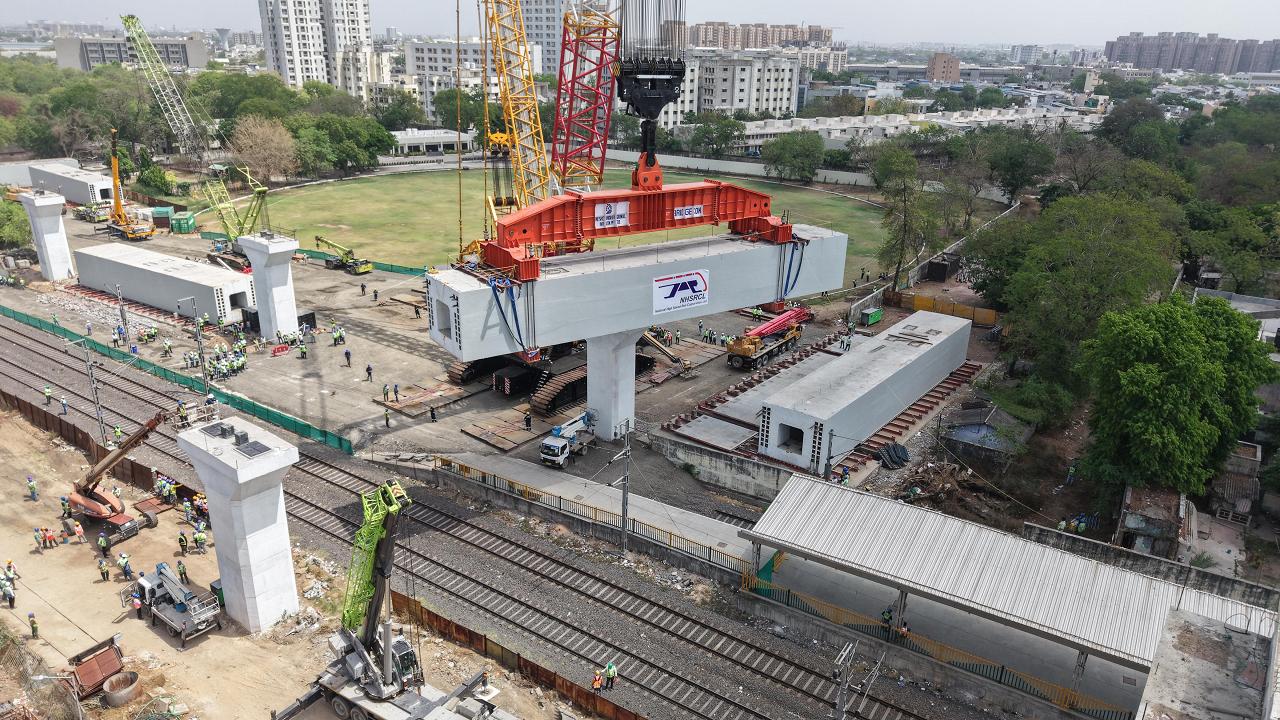
In a major engineering milestone for India’s high-speed rail corridor, a massive 1,360-tonne precast portal beam has been successfully launched over an operational railway line near Maninagar in Ahmedabad. The structure forms part of the under-construction Mumbai-Ahmedabad Bullet Train Project.
One of the Heaviest Lifts Over Active Railway Lines
The portal beam—measuring 34 metres in length and with a cross-section of 5.5 metres by 4.5 metres—is among the heaviest structures ever installed over active tracks of Indian Railways.
Officials said five such beams are planned in the Maninagar section, each being cast on-site and installed as a single integrated unit. The beams will support elevated sections of the high-speed rail corridor passing above existing railway infrastructure.
Execution Window Cut From Hours to Minutes
The installation was carried out during a coordinated traffic and power block on the Amdavad–Vadodara route. What makes the operation notable is the sharply reduced execution time.
Earlier plans had envisaged multiple blocks of up to nine hours spread over several months. However, engineers completed the entire launch in approximately 3.5 hours, minimising disruption to train services on one of the region’s busiest rail corridors.
Heavy Machinery and Precision Engineering
The lifting operation relied on a 2,200-tonne crawler crane as the primary equipment, supported by additional cranes and specialised lifting systems. Engineers used high-strength prestressed bars, heavy-duty slings, and custom-designed lifting beams to safely handle the enormous load.
Auxiliary equipment, including standby cranes and man-lifters, was deployed to ensure redundancy and operational safety during the process.
Multiple Engineering Challenges
Executing the launch posed several technical challenges. The sheer weight of the beam required precise load management, while the presence of overhead electrical equipment and multiple live railway lines restricted working space.
The beam had to be positioned at a height of around 15 metres with exact alignment, requiring continuous monitoring and coordination. Teams also kept a close watch on wind speeds due to the large exposed surface area of the structure.
Coordination and Safety Measures
Officials emphasised that the operation was conducted under strict safety protocols, with real-time coordination between project engineers and railway authorities. Redundant lifting systems, detailed rigging checks, and precise survey controls were employed to ensure accuracy and safety throughout the process.
The successful launch marks a key step in advancing civil works on the high-speed rail project, which aims to significantly cut travel time between Mumbai and Ahmedabad once completed.