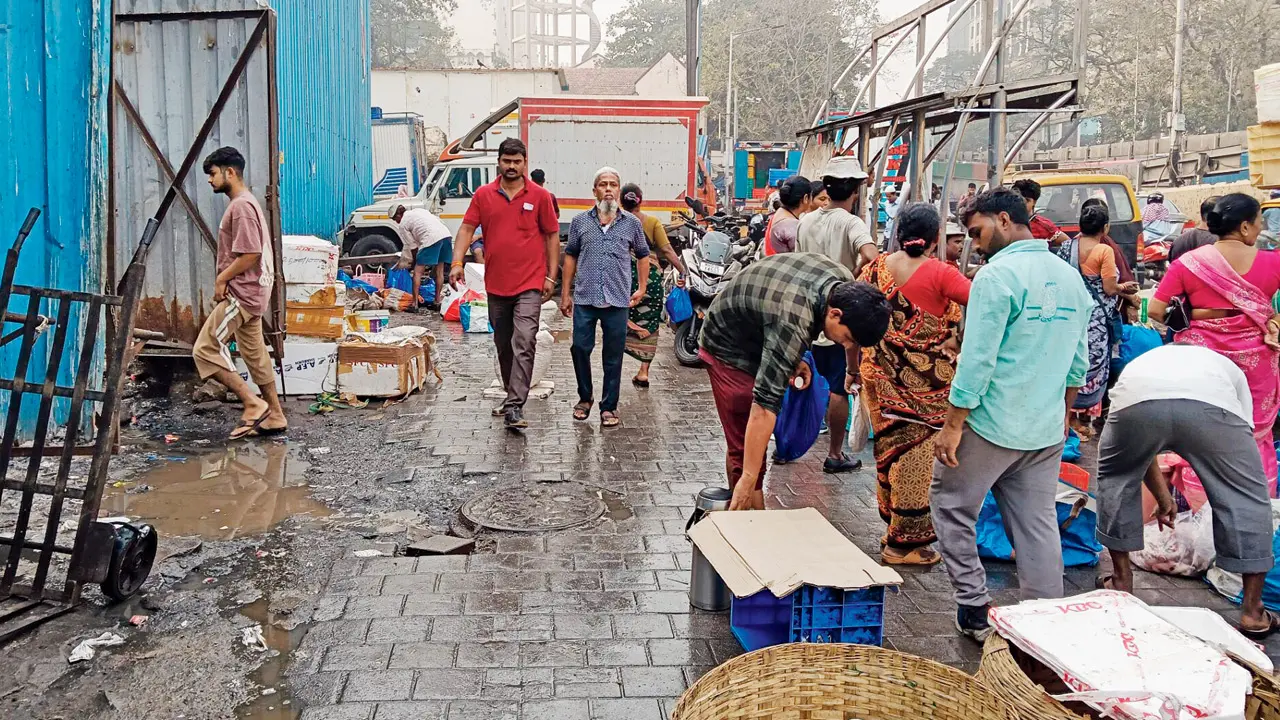
The famed “spirit of Mumbai” lives in an inconspicuous shared lane of a fish market opposite Crawford Market nowadays. “In the early hours, the lane is abuzz with fisherfolk of the Chhatrapati Shivaji Maharaj fish market; you can catch a whiff of fresh catch in the air. By noon, fishy waters dry up just in time for the Mohatta cloth market to take over,” recalls Durva Wairkar, a student of Sir JJ School of Architecture. For the last two months, the batch of M Arch, Metropolitan Architecture at the institute have been following this whiff.
A panel depicts and analyses four possible futures of the market through pros and cons. PICS COURTESY/SIR JJ SCHOOL OF ARCHITECTURE
The nearly 60-year-old fish market was demolished after a structural audit in 2014. It is now home to a makeshift open market, the future of which remains uncertain. “The presence of the market is both historic and functional. It is important to understand not just its past, but to determine its possible futures, whether it is in-situ, relocation, or moving to the new Crawford complex” says Professor Mustansir Dalvi. A Fish Market for the City, an exhibition by the students led by Dalvi and Professor Sonia Saraf will present ideas, proposals, and learnings from a three-month effort.
An illustration of the types of fish sold at the CSM Fish Market
TILL April 10; 11 am to 5 pm
AT Claude Batley Gallery, Sir JJ School of Architecture, Fort
Students’ notes
Mustansir Dalvi
Relocate or revamp? Two students from the batch of seven reveal their proposed in-situ plans for the future of the market in its current location.
Mayuri Chheda
>> The market needs dormant time every day to prepare for the next phase of activities. Building points of attraction in the area will draw in visitors beyond market hours.
>> Experience centre: A viewing gallery dedicated to the Koli fisherfolk will help outsiders understand how the fish industry works
>> F&B revamp: Clean and audited food establishments serving fresh catch from the market will be a win-win for the sellers as well as visitors
Durva Wairkar
>> Passers-by usually complain and avoid the lane because of the strong odour of fish that lingers after market hours. We’re proposing a new non-air-conditioned space that leverages natural airflow to help ventilation
>> Curtains made out of jute sacks can absorb the odour and create a buffer area
>> A more efficient drainage system to ensure zero stagnation