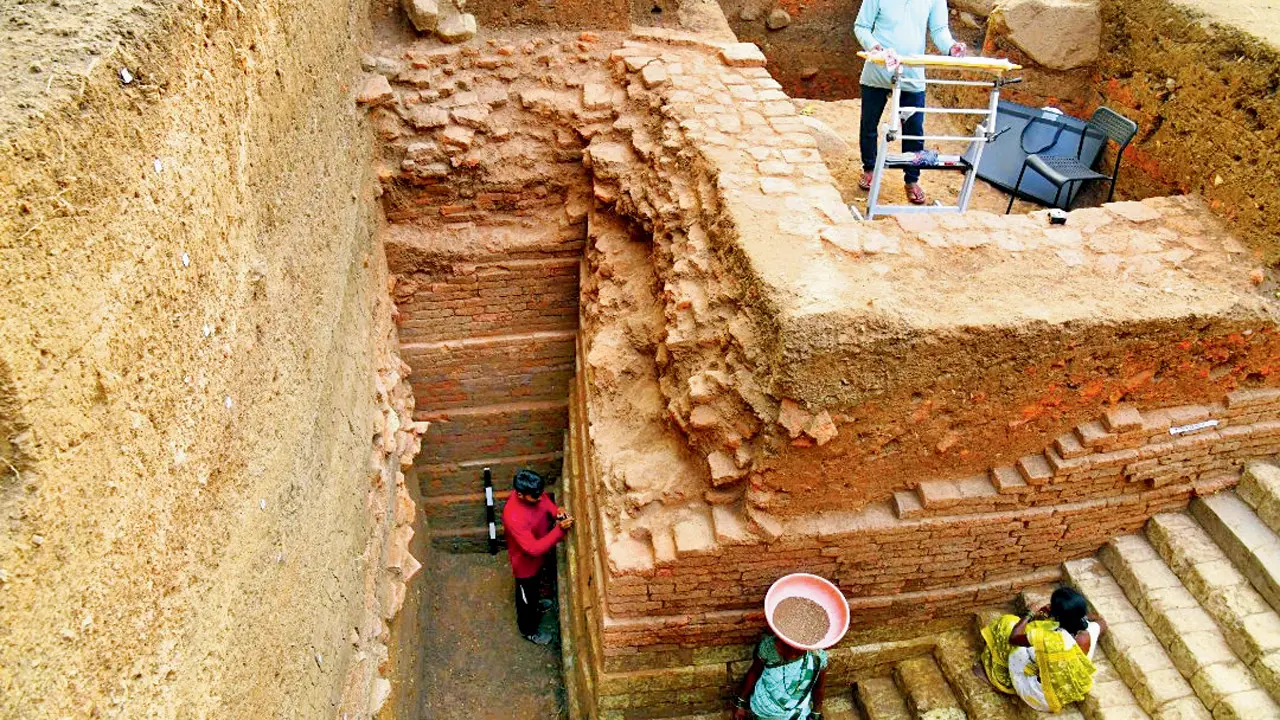
A stone-and-brick reservoir, believed to be over 1500 years old, has been unearthed on Elephanta Island, showing how ancient inhabitants managed drinking water despite heavy rainfall and rocky terrain that cannot retain it.
Beyond caves
Elephanta is known for rock-cut monuments, but this tank is engineered, not carved, marking a different approach to infrastructure.
“This clustering of caves on islands is not incidental; island cave sites repeatedly occur in zones of intense movement, exchange and patronage.
Across western India, caves functioned not only as religious spaces but also as institutional nodes embedded in mercantile networks,” said Dr Abhijit Ambekar.
What was found
>> A massive T-shaped stepped tank engineered into rock to store rainwater
>> Excavation by the Archaeological Survey of India began in November 2025
>> Indo-Mediterranean (Roman) amphora sherds, along with imported ceramics and glass
>> Artefacts linked to regions like modern-day Turkey, Syria, Kuwait, Israel, and Egypt
What it suggests:
Elephanta was part of a long-distance maritime trade network
The structure, up close
Age: 1500 years
Type: T-shaped stepped reservoir
Material: Stone and brick
Length: 14.7 m
Depth: 5 m
Steps: 20
Function: Rainwater storage and regulation
Solved: Water scarcity after monsoons
Expert view
An official associated with ASI pointed out that several cave sites already exist on the Mumbai mainland:
>> Kanheri Caves
>> Mahakali Caves
>> Mandapeshwar Caves
>> Jogeshwari Caves
>> Despite this, Elephanta was developed as a major site, indicating its strategic role as a trade hub
Why it matters
Shows advanced water management adapted to monsoons and rocky geography
Indicates long-term planning for drinking water security
Suggests Elephanta was not just religious, but also economically active
“This means Elephanta was not an isolated ritual space but part of wider maritime movement,” the ASI noted.