Pehle hum gaali dete the, ab dialogue maarte hai, [Earlier we would converse in profanity, now we talk in dialogues].” That’s the power of theatre for you, in the words of a child actor from the Umerkhadi Observation and Children’s Home, Dongri. They’re not the only ones finding a new side to their personality through the art form. From underserved, orphaned, and incarcerated children, to those with mental and physical impairments, there’s a whole world that’s waiting for a spotlight.
Blockbuster dreams
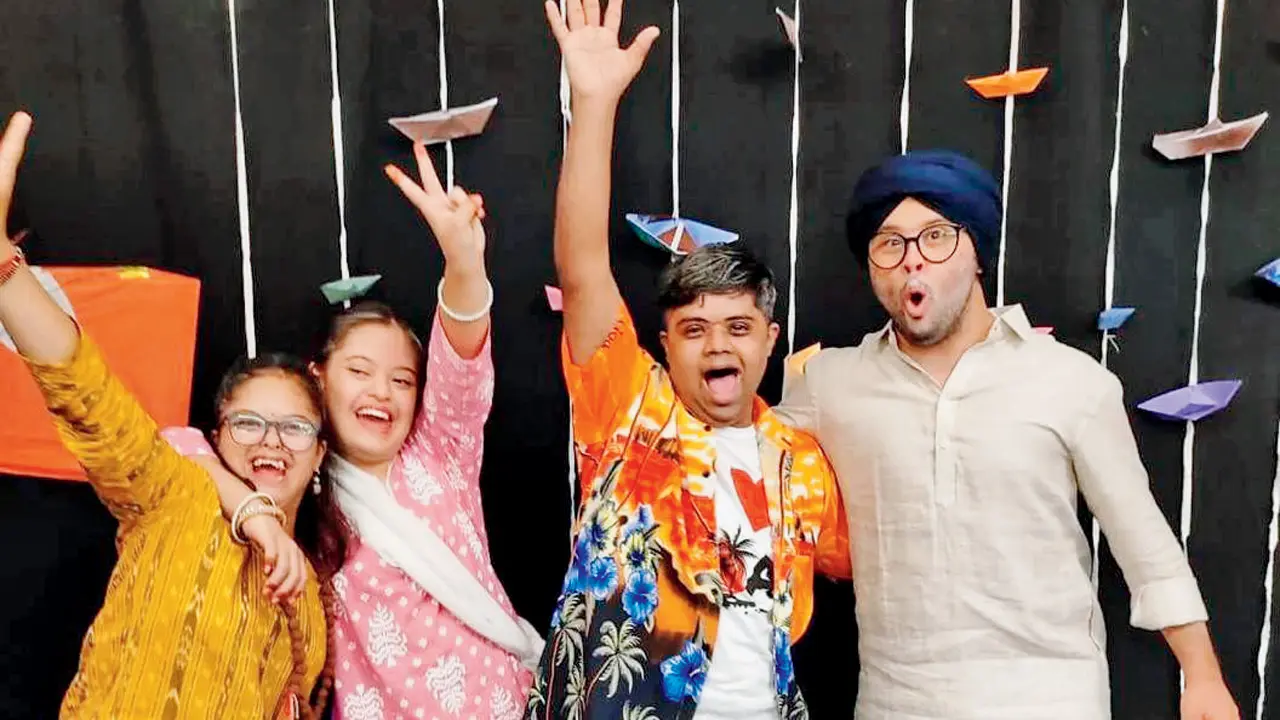
In Andheri, theatre maker Anupama Chouhan runs Raashaa Theatre for those with Down Syndrome and individuals on the autism spectrum. Nearly 20 aspiring actors learn body movement, vocal exercises, and screen presence. “Beyond the stage, it helps them open up about their emotions, and express their needs boldly,” she says. Their 2024 play Woh Khula Aasman ushered the young group into limelight. Recently, one of the students, Ahida, played actor Arjun Rampal’s daughter in the film, Dhurandhar: The Revenge (2026).
LOG ON TO @raashaa_theatre
Screen memories
Anupama Chouhan Ahida Sarmai with Arjun Rampal and Ranveer Singh. PICS COURTESY/RAASHAA
I’ve always had a knack for acting. When one of my Instagram reels went viral, it reached the Dhurandhar team, and they reached out for an audition. My time on the set of the sequel was seamless.
Arjun sir made me feel comfortable and even called me a ‘cutie’ actor. I met Ranveer sir at the premiere in Mumbai, and he told me that I absolutely nailed the part. I’m elated, to say the least.
Ahida Sarmai, actor, 17
We’re all eyes
Change is in the offing not only onstage, but in the audience as well. Mira Road-based Siddesh Nayak has been organising play viewings for those with visual impairments. A sighted volunteer from his group is seated between two visually impaired members.
Visually impaired persons experience the play, Rashtragranth. PIC COURTESY/SIDDESH NAYAK
Developments like the movement of characters, gestures, and change in location are whispered to the members in the least number of words possible. “It requires nothing to be their eyes for a few hours. I wish more people take up the initiative across India,” Nayak says.
LOG ON TO @blind_who_trek
Space, please
Initiatives for the visually impaired significantly enrich the overall experience of appreciating the artistic performance. Ideally, every theatre venue should be fully accessible to individuals with diverse disabilities, whether they face mobility challenges, visual impairments, or hearing impairments. I would love to see concessions on ticket prices for persons with disabilities as well. It will help them develop an interest in performing arts.
Nikhil Bhalerao, person with visual impairment, 31
Early days of theatre
Mumbai’s tryst with commercial theatre (in the current form of an enclosed stage and an audience) dates back to 1853, when the legendary dramatist Vishnudas Bhave came to (then) Bombay after successfully staging plays in Sangli, his birthplace, since 1843.
Vishnudas Bhave. PIC COURTESY/ Vishnudas Bhave Natyavidyamandir
His most famous play was Sita Swayamvar. In Bombay, he staged Indrajit Vadh (The Assassination of Indrajit) at Grant Road Playhouse (also known as Pila House), and at the home of a philanthropist named Vishwanath Shimpi in Girgaon. Bhave, in whose honour the most famous theatre of Navi Mumbai is named, was inspired by the Western theatre halls of England. However, Bhave’s plays were mostly one-man shows with minimal supporting cast.
Later, in the 1880s, Balwant ‘Annasaheb’ Kirloskar pioneered multi-act plays with bigger casts. His biggest endeavour was Shakuntal based on poet Kalidasa’s epic play, Abhidnyan Shakuntalam. Shakuntal had nearly 200 songs, based on Hindustani and Carnatic classical music.
By Sachin Kalbag
Silver linings
A moment from Second Chance. PIC COURTESY/ASHIYANA FOUDNATION
City-based Ashiyana Foundation is broadening the definition of children’s theatre. The group uses theatre as a tool to sow hope in places like the Umerkhadi Observation and Children’s Home in Dongri, David Sassoon Industrial School in Matunga, and Chembur Children’s Home in Mankhurd.
Their plays Second Home and Ek Aise Gagan Ke Tale were met with thunderous applause across Mumbai venues. “We can already see the culture shift steadily inside these homes. Some of the children never learnt to read because of their circumstances, but they’re now acing 80-page scripts onstage,” reveals director Sachi Maniar.
LOG ON TO @ashiyanafoundation