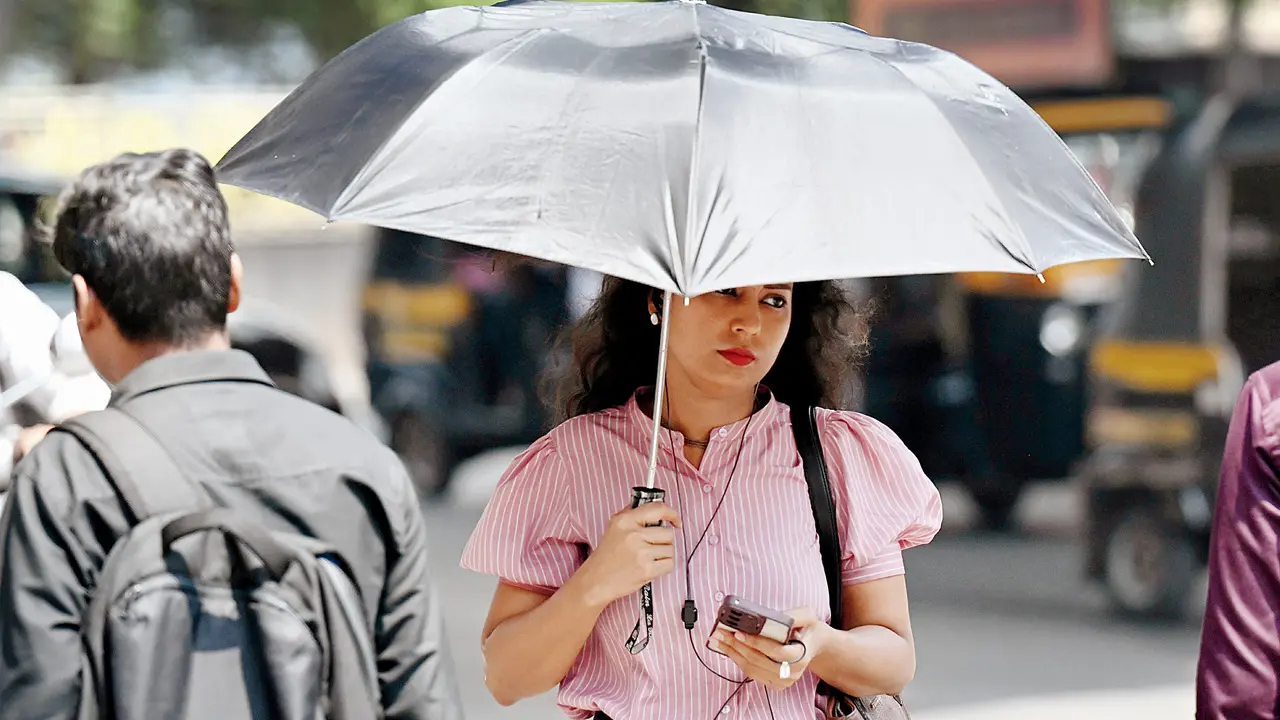
Earlier this week, Mumbaikars experienced an intense heatwave as temperatures in the city touched 40°C, about 6-7°C above the normal March average. It was the first time in five years that Mumbai recorded such extreme March heat, the last instance being March 28, 2021, when the city touched 40.9°C. A recent study suggests that climate change is driving these extreme heat events, not just in Mumbai but across several parts of India.
What makes the heat unusual is that it has occurred despite the presence of La Nina, a climate pattern linked to cooler sea surface temperatures in the Pacific Ocean that typically brings relatively cooler conditions, especially to coastal cities like Mumbai. La Nina events usually occur every two to seven years, and the most recent one occurred in 2025.
A youngster enjoys an ice-gola in Kandivli on Friday. PIC/SATEJ SHINDE
According to a study by Climate Trends, a non-governmental climate research group, climate change is overpowering the cooling influence of La Nina, accelerating extreme heat events across India.
In India
Weakening La Nina effect: Even in a La Nina year, 2025 became the eighth warmest year since 1901.
Early onset of heat: Several regions are experiencing heatwave conditions weeks before the typical summer.
Shrinking winters: Winter rainfall has been extremely low despite multiple western disturbances.
Missing spring: India has largely skipped the usual transition into spring.
What is La Nina?
La Nina is a climate pattern marked by the cooling of ocean surface temperatures in the central and eastern Pacific Ocean, along with stronger trade winds. For India, it typically leads to:
>>Stronger monsoon rainfall
>>Colder-than-normal winters in northern India
What is El Nino?
El Nino is the opposite phenomenon, marked by the warming of Pacific Ocean waters. It often leads to:
>>Heatwaves in India
>>Weaker monsoons
>>Drought conditions and agricultural disruption
Mumbai temperatures
Observatory readings
Colaba: 34.2°C
(Departure: +2.6°C)
Santacruz: 37°C
(Departure: +3.8°C)
Area-wise temperatures
Vikhroli: 39.7°C
Ram Mandir: 38.6°C
Vidyavihar: 37.9°C
Tata Power Chembur: 37.1°C
Dahisar: 36.7°C
Meanwhile, the India Meteorological Department has also predicted the possibility of unseasonal rainfall in Mumbai, highlighting the increasingly unpredictable weather patterns affecting the region.
Humidity
The study also notes that coastal areas such as Mumbai are experiencing hot and humid conditions due to rising relative humidity. Increased moisture in the air raises the “feels-like” temperature, also known as the wet-bulb temperature.
Why this matters
When the human body’s temperature rises above 37°C, sweating helps cool it down. However, high humidity slows evaporation, making it harder for the body to release heat. This increases the risk of heat-related illnesses and fatalities.
March 28, 2021
Day city temperatures last touched 40.9°C