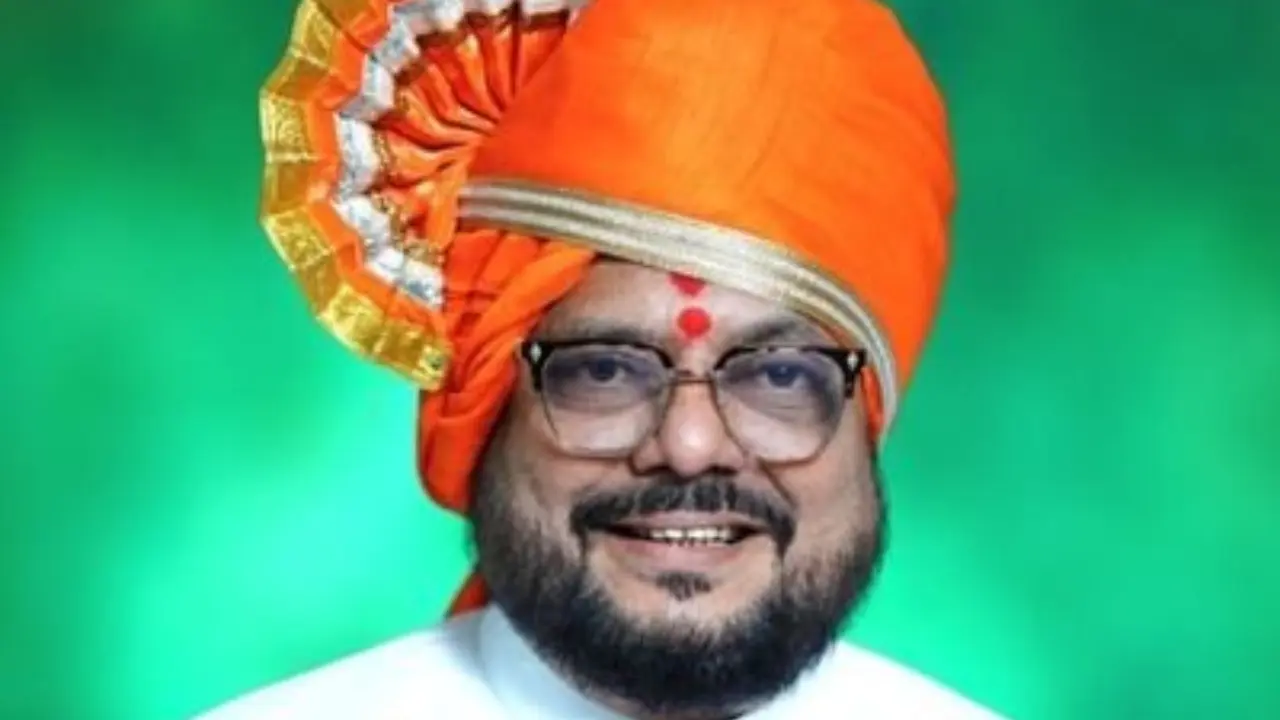
It’s not every day that you interact with the descendant of an admiral whose heroics graced the pages of your History textbook in school. Last weekend, Raghujiraje Angre, ninth generation descendant of visionary Maratha admiral Kanhoji Angre, was in the city to inaugurate Shastrāstra, an exhibition on the history of war through weapons and sculptures dating to 15th and 16th Century India. It was organised by the Department of Ancient Indian History, Culture and Archaeology of St Xavier’s College (Autonomous), with The Museum Society of Mumbai and CSMVS. In between marvelling at these historic exhibits and patiently answering queries from visitors, he spoke about the Angre legacy.
Excerpts from the interview.
Tell us about your family’s connection with Maratha naval military warfare.
My family has always been connected with the manufacture of arms and ammunition. Back in the 16th and 17th centuries, my forefathers, Kanhoji Angre and his children were focused on shipbuilding and Maratha warfare tactics. There was overt dependence on the Portuguese, and later, the British (East India Company) for metal. Kanhoji built his own foundry, and he envisioned designs for cannons that are still seen in our Maratha forts.
Dr Pheroza Godrej, chairperson, Museum Society of Mumbai looks at the cannon ball displays
The Angres concentrated on metal and Indian weaponry, and created indigenous versions and adapted them to suit local requirements, including factoring the build of Indians rather than accepting foreign weaponry templates.
…And Kanhoji Angre had the vision to do this back in the 1600s?
Yes. A lot of people worked in the Angre foundries, and plenty of research went into developing this indigenous weaponry. Local knowledge also helped. The British and Portuguese were blue water navies whereas the Maratha navy was a brown water navy. They understood the terrain very well. Those who were employed by Kanhoji Angre and the Marathas were familiar with the terrain, and thus their knowledge superseded that of their rivals during battles along Maharashtra’s coast.
Raghujiraje Angre inaugurates the exhibition. Also seen in the frame are Dr Anita Rane Kothare and Dr Pheroza Godrej. PICS/ASHISH RAJE
How important is it to document warfare?
It is of utmost importance. In Europe, maritime legacy is well preserved. Unfortunately, it’s not too visible here. Look at the irony… just across the road from here, near Sardar Griha building a cannon is covered under a shanty. I discussed this with the Archaeological Survey of India (ASI). I hope necessary measures will be taken to remedy it. It’s part of our naval treasures, and historic documentation, and must be preserved. I am hopeful that change will emerge.
An exciting development is the upcoming National Maritime Heritage Museum in Lothal, Gujarat, which is the Prime Minister’s dream project. It’s shaping up well into one of the world’s largest maritime museums. I am involved with setting up the Maratha gallery section.
What are your plans to showcase Alibaug’s maritime roots?
Work is in the pipeline; I’m keeping my fingers crossed. The Chief Minister of Maharashtra, Devendra Fadnavis has given the go-ahead for these plans, which includes a gallery. We must try to preserve our heritage and also instill awareness. With the Trans-Harbour Link and the Rewas-Karanja Bridge, Alibaug will transform rapidly. So, when tourists come here it shouldn’t be to just chill or savour our seafood, but to also experience our culture. We are keen to change that narrative.
School children attend the exhibition at St Xavier’s College
What is being done to protect the Angre legacy?
We have preserved arms and ammunition, as well as weapons from that era. There is also the Kanhoji Angre Samadhi campus that we recently restored with support from the state archaeological department. Plans are afloat for a show at the site.
What are some of the valuable lessons that Kanhoji instilled in maritime warfare?
Let’s look at it the other way. When we refer to India’s borders, we immediately think of Wagah or Attari. But we also have coastal borders, and Mumbai is located along this border. Our nation has 7500-plus kilometres of coastline. So, when attacks emerge from the sea, Mumbai is under direct threat. The sea is a vulnerable natural factor. It isn’t just the duty of the Navy or Coast Guard; commoners too need to be vigilant.
Kanhoji Angre
We conduct awareness drives among coastal communities in the area. For example, if an unidentified person is spotted, or if suspicious activity is noticed, it is reported back. The same practice was followed 300 years ago in Kanhoji’s time. Until any ship or vessel docks at the port, it doesn’t mean that it has reached its destination. At the port itself, strict checks are needed to prevent invasion.
Kanhoji followed this practice. It’s why the Konkan has the highest density of sea forts as compared to any other part of India’s coastline. There are sea forts at an average of every 15 kms. Such was his vision.
Did you know?
Blue water navy: When a country is able to protect naval power away from its own country, at a global level
Brown water navy: When a country guards its waters near its territorial borders, within its inland waterways