A 21-year-old MBBS student, Harsh Jain, who was left paralysed after a devastating road accident in late January, has regained movement and is now walking with support. This, despite him being brought to hospital nearly 48 hours after sustaining the injury. Recalling the accident, Jain said, “I was riding my two-wheeler near my college at Karad in Satara late at night. Suddenly, I fell into a deep pit. I don’t remember if road work was being carried out at the spot or whether it was a building construction site,” said Jain.
Harsh Jain (grey shirt), who is recovering from paraplegia, stands tall at Jupiter Hospital in Thane. PICS/BY SPECIAL ARRANGEMENT
Though Jain’s friends had taken him to the hospital of their medical college as soon as they learnt of the accident, the golden hours had passed, with the youth not getting adequate treatment in the advised time window. By the time the youth was admitted to Jupiter Hospital in Thane in early February, based on a relative’s advice, he had completely lost movement in his lower limbs owing to paraplegia.
Challenges faced by surgeon
Explaining the challenges faced while operating on Jain, Dr Priyank Patel, orthopaedic spine surgeon, Jupiter Hospital, said, “The biggest challenge was the delayed arrival of the patient to a specialised spine centre. In spinal cord injuries, the first few hours after trauma are extremely critical, as ongoing pressure or instability can worsen damage to the spinal cord. By the time the patient reached us, he had already lost movement in both lower limbs, indicating a severe neurological injury.”
The MBBS student hopes he will not lose an academic year, as he could not sit for the first third-year internal exam
Another concern was safe handling and transport, as improper movement without spinal immobilisation can aggravate the injury. “Despite missing the ideal treatment window, our priority was to stabilise the spine, decompress the spinal cord, and prevent further damage,” Dr Patel said.
It may not be too late
What made this case encouraging was that the spinal cord was not completely severed, reinforcing an important message that while early intervention offers the best outcomes, delayed treatment should never be considered futile. With timely surgery, structured rehabilitation, and patient determination, meaningful recovery is still possible.
The role of rehabilitation
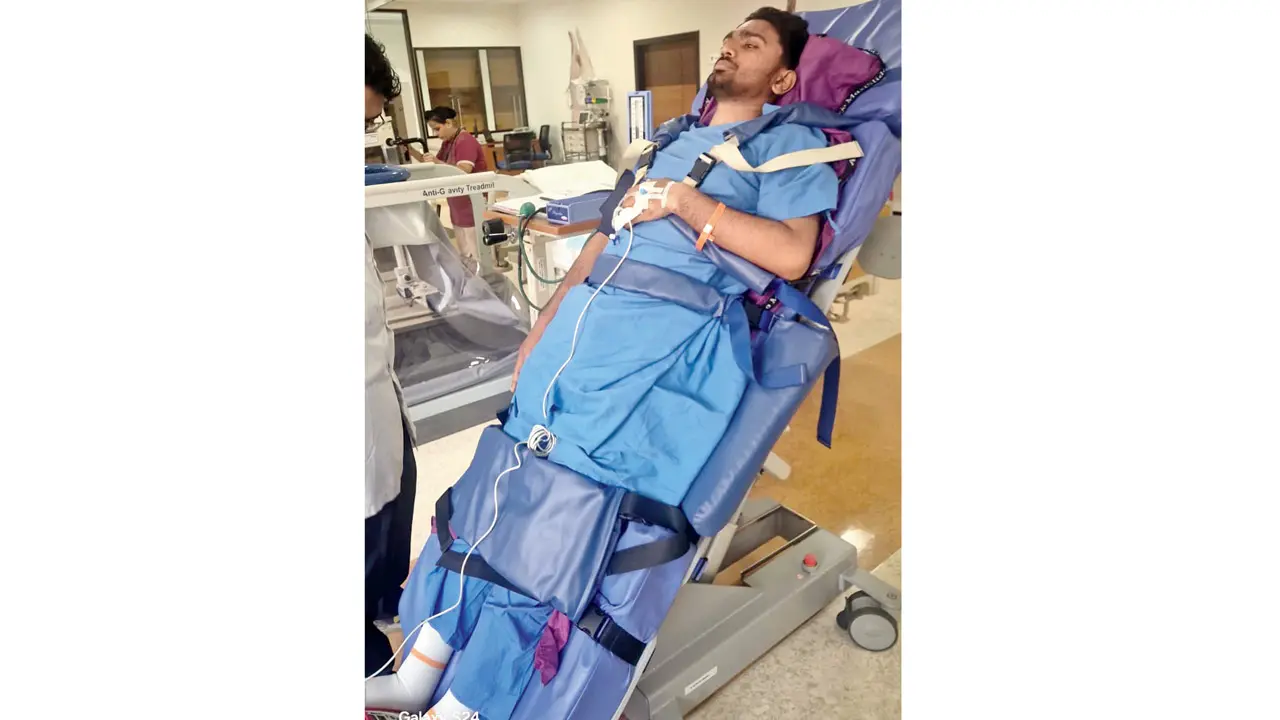
Dr Priyank Patel mentioned that rehabilitation played a crucial role in this patient’s recovery. Surgery stabilises the spine, but recovery of movement and independence depends heavily on consistent rehab. In this case, rehabilitation started within 24 hours after surgery with early mobilisation, sitting support, assisted standing, and guided walking exercises.
Academic plight
Jain said that as a result of the mishap, he couldn’t sit for the first third-year internal exam. “The next exam, a preliminary one, will be conducted in July. However, to be eligible to appear for my final third-year exam, I need to score at least 50 per cent in both these exams. I have requested my college to write to the university to allow me to take the July prelims and final university exam. If my case is not considered, I will lose a year,” he said.