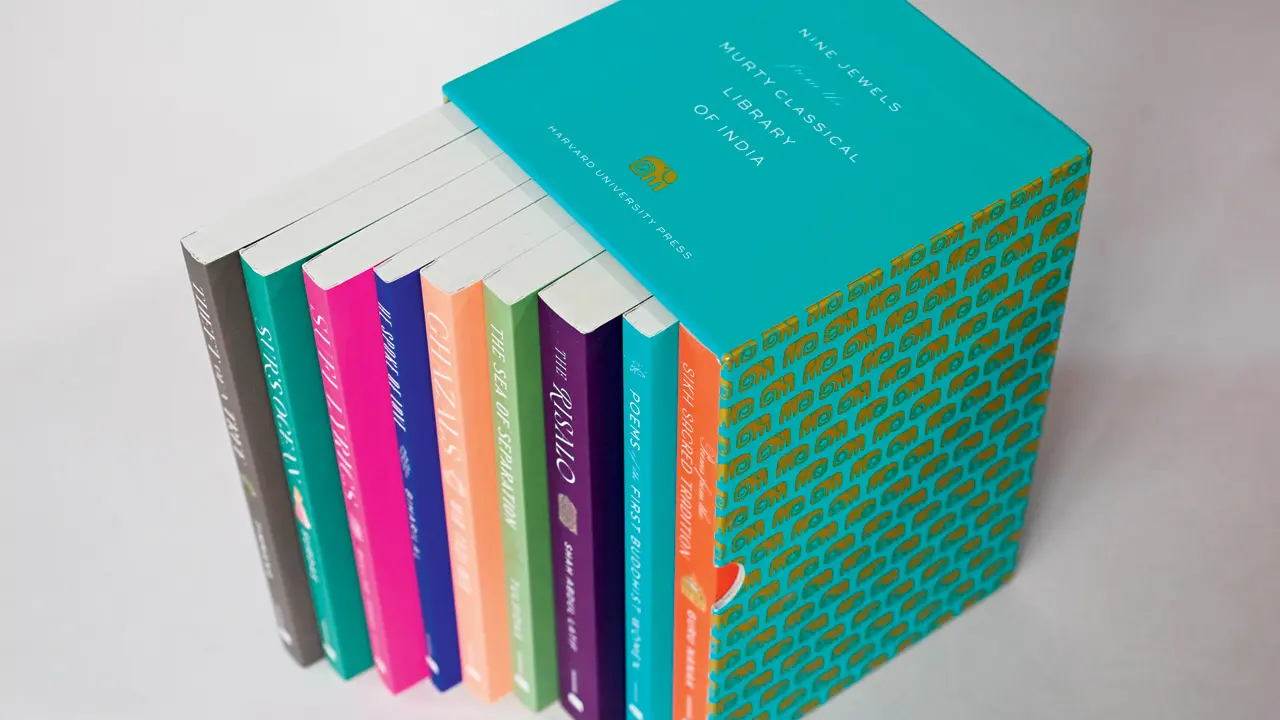
The Nine Jewels: A Box Set is the latest offering from Murty Classical Library of India published by Harvard University Press. Sharmila Sen, editorial director of Special Initiatives, at Harvard University Press (which publishes the Murty Classics series), reveals that the collection spans nearly 2000 years and showcases India’s extensive, often untapped regional language archive. Readers can pore over writings by the first Buddhist theris (senior nuns), as well as soak in the magic of Mir Taqi Mir’s ghazals. These commissioned translations are encased in an Indian motif design box and are perfect for gifting, or to elevate your home library.
Excerpts from the interview
What was the driving force behind putting together this eclectic box set? Also, why nine titles?
There are many gems in the Murty Classical Library series, but we thought it would be an interesting idea to introduce the list by putting together the nine paperback editions published in the series so far, in a beautiful box. Since we’re talking about classical literature, this is our version of the Navaratna — hence the name, The Nine Jewels. The box set is ideal for readers looking to grow their personal collection, and we hope it will also make for an excellent gift to booklovers.
This set, individually, and as a collection, represents the breadth and depth of India’s literary landscape as well as its multiculturalism, and rich cultural diversity…
This is exactly what we aimed to show with this box set. Consider it a relatively inexpensive and accessible armchair journey across the entire Subcontinent, without hitting the road or procuring passports and visas. This is a sampling, and not an exhaustive collection of all the literary traditions of India. It is a starting point, hopefully, of a lifelong journey of discovering new classic works.
Which of these titles offered the biggest challenge to be translated?
That is a difficult question to answer because the challenges inherent in each text are not commensurate. I will invite the readers to guess the answer. Here is a tip: The translation that seems most simple, where the target language, English, doesn’t call any more attention to itself [than the original, source language does], is usually the one that has been most rigorously crafted. It takes a lot of effort to make things seem effortless in all aspects of life, and especially in writing.
What will be the biggest takeaway for the discerning reader — the meaning-making, so to speak?
We might know much more about our distant friends than our next-door neighbours or even those who live under our own roof. The “discerning” reader might be more familiar with great fiction written by English, Irish, French, German, Italian, Russian, American, Colombian, and Korean novelists. But we might not yet have discovered literary gems from the Indian state or the district next door, or even in our own mother tongue.
There is a famous Tagore poem many Bengalis will recognise: “Dekha hoi nai chokhhu melia/ghor hotey shudhu dui phelia/ekti dhaner shisher uporey ekti shishirbindu.” [Translation: While I have travelled the world, I have not really opened my eyes and seen, two feet away from my home, on a single blade of grass the single dewdrop.] This set represents to me nine dewdrops on nine blades of grass outside our home.
What is the aim of the Murty Classical Library?
Keep reading classic Indian works in translation; keep discovering the shishirbindu (dewdrop) on the dhaner shish (blade of grass). The box set is a gentle invitation to a deeper dive into those bilingual editions. Though this is a translation series, we offer bilingual editions because we are equally committed to original languages and their beautiful writing systems.
Available: Leading bookstores and e-stores
Biharilal, He Spoke of Love: Selected Poems from the Satsai (Translated by Rupert Snell)
Bullhe Shah, Sufi Lyrics: Selections from a World Classic (Translated by Christopher Shackle)
Guru Nanak, Poems from the Sikh Sacred Tradition (Translated by Nikky-Guninder Kaur Singh)
Mir Taqi Mir, Ghazals (Translated by Shamsur Rahman Faruqi)
Nandi Timmana, Theft of a Tree: A Tale by the Court Poet of the Vijayanagara Empire (Translated by Harshita Mruthinti Kamath and Velcheru Narayana Rao)
Poems of the First Buddhist Women: A Translation of the Therigatha (Translated by Charles Hallisey)
Shah Abdul Latif, The Risalo of Shah Abdul Latif: Sufi Poetry from Sindh (Translated by Christopher Shackle)
Surdas, Sur’s Ocean: Classic Hindi Poetry in Translation (Translated by John Stratton Hawley)
Tulsidas, The Sea of Separation: A Translation from the Ramayana of Tulsidas (Translated by Philip Lutgendorf)